Showing posts with label Izbitz. Show all posts

Wednesday, December 18, 2013

Dixie Bit: The essence of Binyomin, Yosef, and Yehuda (Izhbitz and Beis Yaakov)

Dixie Bit: [short ideas taken from various sources or my thoughts - not as well formed or with clear citations as a proper blog post]
 
Who and what is Binyomin as a shevet and in his essence? The following is based on the Mei Hashiloach and Beis Yaakov of Izhbitz.

As I've posted before, the essence of Binyomin is the ability and proclivity to take the good from the nations of the world and the physical world generally and bring it into the Jewish people, and thereby, back to its source, Hashem. This is the avodah of "v'yinatzlu es Mitzrayim, and you shall empty out Egypt," mentioned in the last pasuk of the 2nd perek in this week's parsha (Shmos).

This is based on Yaakov's blessing, "Binyomin is a Wolf that tears" sparks of holiness from the nations of the world in order to bring them into the Jewish people. It is also based on the stone from the Ephod corresponding to shevet Binyomin, the "yashpeh" which the Izhbitzer says is a contraction of the words "yesh peh, there is to him a mouth" to consume the holiness that is trapped among the nations of the world to bring it back to the Jewish people.

Why is Binyomin consumed by the need to look for holiness outside the walls of the beis medresh in order to bring it back? Why is he not satisfied and calm, willing to look for holiness only where it is apparent? Why isn't he patient enough to wait for "b'ita, its time," the appointed time of redemption when Hashem Himself will bring back everything to its source and redeem those sparks of holiness Himself when He decides the time is ripe? Why must he insist on "achishena, I will hasten it?" Why must he reach into the mud to bring goodness back *now*?

The Izhbitzer's son, the Beis Yaakov, gives us the backstory.

The Beis Yaakov explains the differences between Yehuda, Yosef, and Binyomin. In short, their essences are the following (I'll note below some obvious questions about the following given other things we know about these players):
  • Yehuda is the tzadik who recognizes that the whole purpose of life is the higher world. This world is transient and our avodah is to live purely for the higher world. He is patient and will wait for "b'ita, its [the redemption's] time." He has no need to live for or see the redemption of the holiness that he know intellectually exists in this world. So he is patient and doesn't see the rush to involve one's self in the physical world or the nations to redeem the holiness trapped there.
  • Yosef expands on Yehuda's satisfaction with only involving one's self with things that are already outwardly spiritual. He stretches out Yehuda's interests by showing how there is value in being involved in the world, settling and improving it. Yosef takes care of every detail of running a country. He gives Yehuda the ability focus on those details of this otherwise insignificant world in Yehuda's own malchus.
  • Binyomin takes this a step further. He is not satisfied with "b'ita," waiting until Hashem is good and ready to redeem the holiness within this world at the end of time. He has no patience for that. He demands redemption in the way of "achishena, I will hasten it." That is why he looks to the good points within the physical and within the nations of the world in order to take them away from their captivity there and bring it into the Jewish people, Hashem's bride, into Hashem's household. He must do this now, before the ultimate redemption.
This is why Yehuda was so distraught when he came to Yosef-viceroy at the beginning of Vayigash. He knew that his kingship had no staying power in this world without Yosef and Binyomin. Without a focus on the good/the value in this world, Yehuda would disappear as far as any existence in this world goes. Granted, he was part of the cause of the loss of Yosef, but sometimes "you don't know what you've got till it's gone."

Yehuda had already lost Yosef, which, together with his intent to focus on the higher world, gave him the ability to extend his upper-worldly life into this world. But at least he still had Binyomin. Now, though, Binyomin was about to suffer the same fate as Yosef. He was about to be swallowed up by the very impure world he was trying to redeem. Yehuda therefore guaranteed Binyomin's return to his father Yaakov. If he lost Binyomin, he would have no further reason to live in this world, so he guaranteed Binyomin's return with his own life.

And by doing so, Yehuda merited not only the ability to retain physical life by keeping Binyomin's influence in his life, but he also merited to regain Yosef's influence as well.

We can see from this how all types of Jews and darchei avodah across the spectrum (i) of living only for apparent holiness while rejecting any essential purpose in this world, on one hand, to (ii) intense involvement with the nations and the physical world, on the other hand are both needed. It is a symbiotic relationship whereby we are only complete as a people when we have both sides to do their respective jobs but also to keep the other side grounded and balanced.

I previously commented that Binyomin would be a great name for a Ger because such a person extracted his own soul from captivity among the nations. It's not a completely clean extraction though. There's junk that comes along into the Jewish people along with the holiness that had been there. Binyomin struggles to cleanse himself from that junk while still able to see the good in the world outside and trying to bring it up without being taken captive again by it. He must be anchored by the purity of Yehuda who'll save him from the brink when he's almost lost.

***

As I learn more, I don't yet know enough to fully get my head around these ideas or how they shtim with the fact that Yehuda is the son of Leah, the embodiment of the "alma d'iskasya, the hidden world." He should be the one to look for the hidden kedusha in this world, right? He's also malchus, the ability to bring all of the higher kochos all the way down into the details of this world. Isn't that the essence of malchus? Why does he need Yosef for that? Or is Yosef the reason why Yehuda can do it? But if so, what is malchus?

And Binyomin is a son of Rochel, the embodiment of the "alma d'isgalya, the revealed world." Shouldn't that mean he's the one who only deals with the world of revealed holiness, nigleh? Shouldn't he be the one with patience who doesn't need to see how the hidden holiness in the physical world will return to the world of holiness? He should be satisfied with the revealed holiness of the spiritual world and not so preoccupied with revealing that which is hidden.

Perhaps some of you can help me fit some more pieces of the puzzle together.

Friday, April 9, 2010

Rabbi Boshnack's Shiur on Sfiras HaOmer & His New Beis Yaakov of Izbitz Source Sheet

Rabbi Boshnack has done it again. Please CLICK HERE for a pdf he used a shiur on the Beis Yaakov of Izbitz on Parshas Shemini. It's amazingly elucidated and illustrates how the Izbitzer can show you a new way to look at things. It's eye opening and explains what the Beis Yaakov is saying very well. His sheets are also organized to highlight the inevitable "Izbitzer Twist" and the "Practical Advice" that comes from the Torah.

Also, he gave a shiur on Sefiras HaOmer which you can listen to AT THIS LINK. (47 MB mp3 file)

Picture courtesy of Rabbi Boshnack's Fan Club. Click here to get Dixie Yid in your e-mail Inbox or here to subscribe in Google Reader.

Friday, February 12, 2010

Amazing Elucidated Sourcesheet on Beis Yaakov of Izbitz by R' Reuven Boshnack

Reb Reuven Boshnack, (JLI Rabbi at Brooklyn College, therapist, and up-and-coming dayan) has put together a very nice sourcesheet on a piece from the the Beis Yaakov of Izbitz on Parshas Mishpatim. He's put it together in a very creative and thoughtful way.

It includes 1) the actual text of the Beis Yaakov, scanned, 2) a section called "Musagim," Concepts, which sumarizes the major concepts brought out by the Izbitzer in that piece, 3) the Izbitzer twist, showing how the the Izbitzer masterfully presents a concept in a way that we wouldn't have expected and 4) a section called "Practical Advice," which gives you a take-away point from the piece.
It's a great thing to learn with a child or Chevrusa. An amazing "study guide." Enjoy!

You can see that pdf HERE.

Click here to get Dixie Yid in your e-mail Inbox or here to subscribe in Google Reader.

Thursday, September 24, 2009

Shabbos Shuva, Yom Kippur, Mikva & the Baal Teshuva- By Rav Zvi Leshem

BS"D

SHABBAT SHUVAH

Removing the Impurity of Our Transgressions

Rav Zvi Leshem

In Al Hateshuvah, Rav Soloveitchik writes that any transgression carries with it two negative repercussions - liability and impurity. Although the sinner is obviously liable to punishment, the more serious issue is the tumah, the impurity that has resulted from the sin. This is not in the technical halachic sense, but rather refers to the metaphysical aspect of the spiritual uncleanness that distances us from Hashem. Consequently, explains the Rav, Yom Kippur has two results, kapparah, atonement, and taharah, purity. Each of these is the antidote for one of the results of sin. Rabbi Yehudah Hanasi held that Yom Kippur provides atonement even if the individual does not repent. While this opinion is not accepted, it nonetheless needs to be understood.

For this reason, Rav Soloveitchik writes, "There is atonement without repentance, but there can be no purity without repentance." In other words, just as the sin has a technical ramification in the realm of punishment, so too can the special holiness of Yom Kippur together with its potent sacrifices technically remove the liability for punishment. But can this properly correct a damaged relationship? Does this relieve us of our personal need to appease Hashem? In this situation, does it give us the status of baal teshuvah, penitent, so beloved before God? Obviously not! That can only be achieved through sincere teshuvah with a broken heart!

In the Mishnah, Rabbi Akiva dramatically declares, "You are happy, O Israel! Before whom are you purified, and who purifies you? Your Father in heaven … just as the mikvah purifies the impure, so God purifies Israel!" The Rav points out that this statement was made not long after the destruction of the Second Temple. The Jews at that time were despondent. With no Temple, High Priest, incense offering, or scapegoat, how could they possibly achieve atonement? They felt doomed to lead eternal lives of spiritual tumah, with no chance of repairing their misdeeds and coming close to Hashem. Against this backdrop comes Rabbi Akiva, the eternal optimist, to remind Am Yisrael that ultimately there is only one source of forgiveness, atonement, and purity - Hashem Himself! Even a mikvah is only a mikvah because God has decreed it to be so. Since we no longer have a Temple, the answer is sincere repentance, which brings with it both atonement and purity. For this reason, Rav Soloveitchik concludes his discussion with an idea found in the Maharal and other sources, and takes the comparison between God and the mikvah quite literally. "We must enter into God, into the holiness of Yom Kippur like we enter a mikvah, with no foreign item interposing between our body and the water, with no part of our body remaining outside of the water." As long as we are holding back, as long as we aren't ready to jump in and completely immerse ourselves in Elokut, we cannot really be purified.

The Slonimer Rebbe writes in Netivot Shalom that the three forces that can purify the Jew are the mikvah, Am Yisrael and Hashem Himself. He then quotes the Beit Avraham that, "just as the mikvah only purifies if there is no interposition whatsoever, so too Am Yisrael can only purify if there is no interposition between one Jew and his fellow." This is, of course, another explanation for the halachically mandated need to appease anyone whom we may have offended before Yom Kippur, and to forgive wholeheartedly anyone who has offended us, even if they did not ask. The Netivot Shalom ultimately sees us going through a process in which the mikvah purifies the body (and one must immerse on the eve of Yom Kippur). The connection with Am Yisrael purifies the lower portions of the soul, and finally, Hashem purifies the higher levels of our souls. This is reminiscent of the Piaseczner Rebbe, who writes that to achieve spiritual unity we must first integrate our own personalities, and only then achieve Jewish unity. After that, all of Am Yisrael can finally unite with Hashem.

On Shabbat Shuvah we enter into high gear preparing for Yom Kippur, which is just a few days away. As we have learned from Rav Tzaddok Hakohen, the Shabbat before any holiday contains that holiday's essence, and in this case that is most certainly true. On Shabbat Shuvah, we can already feel the awe and joy of Yom Kippur, its holiness and beauty. Now is the time to plunge into all of the mikvaot: those of water, Am Yisrael, and ultimately that of Hashem Himself. Wash carefully; remove all particles that stand in the way. Nullify yourself to the purifying powers that surround you. Then you will be ready for a Yom Kippur that provides you not only with atonement, but with purity as well.

BS"D

YOM KIPPUR

Before Kol Nidrei

Rav Zvi Leshem

The Rambam has a famous position that only those Jews who live in Eretz Yisrael are referred to as the tzibbur, the public community. This fact invests the Jews living in Israel with a serious responsibility for our brethren who are still in the Diaspora. The Maharil, in his Laws of Yom Kippur, quotes Mahari Segel, who asks why we have longer piyutim, liturgical prayers, regarding the goat that was offered in the Temple than we do about the scapegoat, whose power of atonement was far greater? One of the answers given is particularly interesting. The goat offered in the Temple atones for violations of the Temple's purity and holiness. Since the Temple's holiness is still in effect even when the building is destroyed, and entering the Temple Mount in a state of ritual impurity is a grievous sin, the Jews of the Diaspora ask Hashem to forgive the Jews of Israel who may have been remiss in this area. This reflects the principle that all Jews are responsible for each other. As a proof, the Maharil cites the confessional liturgy in which every Jew asks forgiveness, in the plural, for a long list of sins he may never have committed, since in fact, each of us is asking for forgiveness for every Jew. Let us take a deeper look at the mutual responsibility that every Jew has for each other.

In Chovat HaTalmidim, the Piaseczner Rebbe describes the states of yichud ilaah v'yichud tata, upper and lower unification. Lower unification takes place within Malchut, the collective body of Am Yisrael. After all of the Jews have united (lower unification), then they can collectively unite with the upper sefirot, i.e. with Hashem Himself, reaching the state of upper unification and rectifying all of reality. The Rebbe uses this idea to explain the statement made before we perform many mitzvot, "for the sake of the unity of Kudsha Brich Hu (Hashem) and the Shechinah (represented by the collective Jewish People) … in the name of all of Israel".

The Rebbe explains that this process actually has three stages. Firstly, each one of us must work to make ourselves into an integrated personality, in which the body, brain, and soul all work together to serve Hashem. We all know that when we are feeling personally "not put together" we are not in a state in which we can maintain proper relationships with other people. Secondly, each one of us must work to unite ourselves with all of Am Yisrael. Unfortunately this is easier said than done, but we must never cease in our efforts to bring authentic unity to the Jewish People. Only after these two aspects have been perfected are we, Am Yisrael, as represented by the Shechinah, able to unite with Hashem. Thus the prayer formula which discusses uniting Hashem and the Shechinah ends "in the name of all of Israel," since the higher unity of God and the Shechinah is absolutely dependent upon the prior unification of all of Israel.

The Piaseczner Rebbe further writes in Zav v'Ziruz, that if we want to make spiritual progress, we should set ourselves an annual goal. Where do I want to be one year from now? What kind of person do I want to be by next Yom Kippur? Then, throughout the year, I should measure myself by the standards of the "new person" and check periodically if I am succeeding in closing the gap between the old and the new. If at the end of the year, I am no closer than I was a year ago, then in a sense I have wasted a year of my life, God forbid. Every year we should make it our goal to work on unity, including the personal, national, and cosmic levels. If we all sincerely make this our top priority, we can, with Hashem's help really change ourselves and the world.

Friday, July 17, 2009

How To Be Lost Even When You Know Where You Are

The following shiur was given last night at Brooklyn College, where Rabbi Reuven Boshnack is the Rav to the student body. He discusses the meaning of "alone" and connects the Jews' travels in Parshas Matos-Masei to our travels looking for our source, our home. Drawing from Rav Soliveichick, the Izbitzer, Rav Kook and many other sources, this is a great shiur to understanding what it means to be alone.

CLICK HERE to download the mp3 shiur. (48 minutes)

Picture courtesy of ollysonions. Click here to get Dixie Yid in your e-mail Inbox or here to subscribe in Google Reader.

Monday, October 6, 2008

Moshe & Rebbe Nachman - Remembering the Purpose of Life


In the 2nd piece in in the Mei Hashiloach in Parshas Vayelech, the Izbitzer comments on the pasuk in Devarim 31:2, "לֹא-אוּכַל עוֹד, לָצֵאת וְלָבוֹא," [where Moshe said about himself that he] can no longer go and come. He points out that Moshe is saying about himself, on his last day of life, that he had reached the highest level of perfection that he was capable of reaching in life and could therefore no longer ascend to any higher level. That is why he had to die at that time, since the whole point of life is to grow to higher levels in Deveikus with Hashem. He was no longer able to ascend, and so there was no longer any point in him living any more.

Along the same lines, Rav Nasson brings down that Rebbe Nachman said said the same thing about himself, in Sichos HaRan, Siman 179, quoted in the Likutei Halachos Chumash, on the above-quoted pasuk. He quoted Rebbe Nachman as saying about himself, "I want to take off my coat (my physical body) already because I cannot stand staying on only one level." He also brought down that Rebbe Nachman said that he had to die because he was already holding at a level above which he could not attain as long as he was still enclothed within a physical body. Therefore, he was longed, in a very strong way, to shed his body and ascend.

What we can gain from such lofty levels by these Tzadikim is the awareness, going into Yom Kippur, that our purpose in life is not just to enjoy life or just be be frum. It is to continue growing in avodas and Deveikus BaShem. Our lives have no purpose and are not worth living if they are not directed toward this purpose.

Today is the first day of the rest of my life. And, as Chazal say, "Na'utz techilas b'sofan v'sofan b'techilasan," ends and beginnings are intertwined. This means that, just as it says in Lecha Dodi, "Sof Ma'aseh b'machshava techila," the end result is always first in thought. One must begin his life (which one does every day, as the expression goes, "Today is the first day of the rest of your life") with the goal of life in mind the whole way through.

May we merit to remember that the purpose of life is to keep growing and not stay static in my and your relationship with Hashem and through remembering this, live lives which lead to that result!

-Dixie Yid

(Picture of the purported Har Nevo courtesy of picasaweb)

Click here to get Dixie Yid in your e-mail Inbox.

Sunday, October 5, 2008

Burning Pre-Shabbos Shuva Question & Answer on R' Leshem's Drasha


I wanted to post this reader's question and R' Leshem's Answer in response to R' Leshem's Drasha that I posted on Thursday, before Shabbos Shuva. I received this question (copied below) Friday morning, but by then it was too late for Rav Leshem to receive the question before Shabbos in Eretz Yisroel. So here is the question and Rav Leshem's answer below!

Dear Dixie Yid,

[Regarding Rabbi Tzvi Leshem's Drasha before Shabbos Shuva that I posted on Thursday] He wrote, "...We must aspire to reach perfect Teshuvah out of love for Hashem on this holy Day. This will ensure that each of us, together with everyone in our community and all of Am Yisrael will be sealed in the Book of Life for the coming year." Is it possible to make make perfect Teshuva, which might(should) involve sincere regret/remorse, and tears... on Shabbos? I don't doubt R' Leshems post for a second, but if there's time left to find out, I would love to know what kind of deep Teshuva we can make, and what it would look like on Shabbos, a day when we aren't allowed to openly grieve even (G-d forbid) the loss of a loved one (assuming one can hold in that place).

I realize that it's 2:30 AM by you, and that this might have come too late, but if you have any insight, I'd love to hear it. I can't claim to have performed the most perfect of avodah this past Rosh Hashana, and I've been praying for help that I can use the 10 days like I've never used them before. Rav Lazer Brody posted a "coincidentally" themed piece on Lazer Beams yesterday, and now I've found your post. I'll take these as roadsigns from the Abishter, but He's leaving the investigation to me. any light or help you can shed would be huge.

Best and blessings to you and yours for a sweet , holy, and lichtigeh Shabbos Shuva!

Sincerely, Ploni

Rabbi Leshem's Response

Dear (Ploni),

Regarding the Teshuva of Shabbos Shuva,
Obviously my phrase "perfect Teshuva" is more of an aspiration and a prayer than (perhaps) a reality. But it is something to strive for. What does teshuva look like on Shabbos when we can't mourn? Why should teshuva be compared to mourning, chalila? It is true that the Alter Rebbe in Iggeret HaTeshuva talks about arousing compassion for your soul, but I don't think that is mourning. The Meor Einayim writes that Teshuva is a mitzvah and must therefore be done in joy. I would think that Teshuva on Shabbat would be Teshuva Ilaa of getting close to HaShem, not the Teshuva of fixing specific sins. If we identify this with Teshuva m'Ahava, Rav Kook writes in Orot HaTeshuva that the remembrance of sins by a person doing Teshuva m'Ahava, should fill him with great joy, as he realizes that all of these sins are transformed into merits. In Keter Shem Tov it quotes the Besht haKadosh that Rosh HaShana (Yom HaDin!) is a happy day, which is why we bentch Shehechiyanu. He continues that the Ari's instructions to cry on Rosh HaShana refer to tears of joy.... I suggest that you also see the Netivot Shalom on Shabbat Shuva Shoresh HaTeshuva in vol. 2 (Moadim).

I hope that these are helpful hints. B'bracha that HaShem should bring us all closer to joyous perfect higher Teshuva m'Ahava, gmar chatima tova,
Rav Zvi Leshem

-Dixie Yid

(Picture courtesy of Rabbi Lazer Brody)

Click here to get Dixie Yid in your e-mail Inbox.

Thursday, October 2, 2008

Shabbos Shuva - Guest Posting From Mei Hashiloach by R' Zvi Leshem


PARSHAT VAYELECH: The Meaning of Hakhel
Rav Zvi Leshem

In Parshat Vayelech, we read about the mitzvah of Hakhel, in which, on the Sukkot after Shemittah [the Sabbatical year], all of Am Yisrael, men, women, and children, gather in the Temple, where the king reads portions of the Torah to the public. All of the people reaccept the covenant in a ceremony that some commentators describe as a reenactment of the giving of the Torah. If this is the case, why is Hakhel held on Sukkot? Surely Shavuot would have been more appropriate.

The Mai Hashiloach gives a fascinating answer. At the end of the Shemittah year, during which everyone has dedicated themselves to spiritual pursuits, there may be a natural tendency to jump on the tractor, get to work in the field and … forget what one learned during Shemittah. The Torah gives us the mitzvah of Hakhel, precisely when the demands of making a living may cause us to forget the spiritual lessons that took a year to learn. Hakhel reminds us that the work we are setting out to do must also be dedicated to heaven.

Similarly, says the Mai Hashiloach, we are accustomed to continue seudah shlishit [the third Shabbat meal] into the night after Shabbat ends, in case we rush immediately into our weekday activities and forget the spiritual lessons we internalized during Shabbat. For the same reason, the Psalm of the day on Sunday includes the words, "The earth and all of its fullness belong to Hashem." When we recite this psalm we are reminded that while we do make Havdalah and separate between Shabbat and the week, our weekdays must also be days of holiness. Rav Soloveitchik wrote in Al Hateshuvah that while there are plenty of Jews who are shomer Shabbos, there are not enough Jews that are shomer erev Shabbos!

This important message, of bringing the holiness of Shabbat into the week through seudah shlishit, and bringing the holiness of the Yamim Noraim into Sukkot, the Time of our Rejoicing, and the entire year through the mitzvah of Hakhel needs to be internalized, giving meaning to our daily lives.

SHABBAT SHUVAH: The First Act of Teshuvah
Rav Zvi Leshem

While we tend to think of Shabbat Shuvah as the Shabbat that happens to fall out during the Ten Days of Teshuvah, in fact the opposite is true. Based upon the Midrash in Bereishit Rabbah the Pri Tzaddik explains that Adam and Chava were created on Friday (Rosh Hashanah). On that very day they also violated the divine commandment not to eat from the Tree of Knowledge and were judged, the sentence being banishment from the Garden of Eden. Nonetheless, they were allowed to spend Shabbat in the Garden of Eden, and were only banished after Shabbat. Why? The Midrash continues that the moment Shabbat began, Adam first grasped the concept of Teshuvah and repented. Hashem knew that Adam would not dare to eat from the Tree of Life on Shabbat, for there is a halachic concept (Aimat HaShabbat) that people are afraid to do the wrong thing on Shabbat.

Every Shabbat has the power to help us do Teshuvah, and we know that even the two words Shabbat and Teshuvah are made up of the same letters. This is a major theme in the Netivot Shalom of the late Slonimer Rebbe.

Shabbat Shuvah, the first Shabbat in the year (i.e. the first of creation), has the greatest power, since on it the first act of Teshuvah in history was performed. Its influence is so great that it lights up the days before and after it, transforming them into the Ten Days of Teshuvah!

We must aspire to reach perfect Teshuvah out of love for Hashem on this holy Day. This will ensure that each of us, together with everyone in our community and all of Am Yisrael will be sealed in the Book of Life for the coming year.

(Picture courtesy of agiftforlaughter.com)

Click here to get Dixie Yid in your e-mail Inbox.

Monday, September 1, 2008

When Should One Rush To Take On New Things? & When Deliberate?


The "other" son of the Izbitzer, Rav Mordechai Yosef Leiner, is Rav Shmuel Dov Asher. He brought a great teaching in Parsas Re'eh in the sefer Neos Deshe, on the pasuk "לֹא-תְבַשֵּׁל גְּדִי, בַּחֲלֵב אִמּוֹ," "Do not cook a kid in its mother's milk." (Devarim 14:21) And big thanks to my friend, Rabbi Reuven Boshnack, for showing this to me.

He said that the yetzer hara (evil inclination) comes to different people in different ways. If someone doesn't actually have the desire to be good, the yetzer hara will just flat-out try to get him to sin. But if a person does want and try to be good, the yetzer hara will act very religious and frum. If a person wants to learn Torah, the yetzer hara will cause a person to think "Who am I to involve myself in such holy things? I haven't even purified myself in even basic matters. Let me first make myself worthy, and then I will learn." Or, if a person is busy with his work, the yetzer hara will say, "How can I learn Torah with so many distractions with all of the work I have to do? Let me first earn enough money and progress to so-and-so point in my career, and then I will be able to learn without all of the distractions of the work-a-day life." Using these tricks, the yetzer hara can cause a person to go a whole lifetime without learning.

He says that instead, when the thought of doing a mitzvah comes into one's head, he should quickly do it right away and not over-analyze about whether or not it's a good idea. The youth of a kid, a baby goat (גְּדִי), he says, refers to alacrity, doing things quickly and with excitement. However he says that the mother goat's milk refers to the trait of doing things slowly and patiently. "לֹא-תְבַשֵּׁל גְּדִי, בַּחֲלֵב אִמּוֹ," then, refers to the idea that one should not cook or destroy the youthful alacrity that one is inclined to exhibit when he thinks of doing a new mitzvah, with the misplaced patience and thoughtfulness of "its mother's milk."

I asked Rabbi Boshnack what he thought the limits of this principal are. It seems to me that the Neos Deshe would agree that some thoughts to do mitzvos that are truly beyond one's self and should not be taken on in haste. For instance, if a regular guy felt inspired to keep a ta'anis dibur ("vow of silence") every Monday and Thursday, though he hadn't even taken the TV out of his house yet, this miiight not be advisable. Reb Reuven suggested that one principal might be that when one is thinking of taking on a new hanhaga, practice, like putting on Rebbeinu Tam Tefillin, he should ask his Rebbe or Moreh Derech.

I was also thinking that perhaps when one is talking about something that universally applies to almost every Jew, he should go ahead and start doing it as soon as his spirit moves him, without prior deliberation. Since it is something that is either halacha or is very widely kept, any thought not to do it is likely to be his yetzer hara trying to cool off his holy fire. Whereas if it's something that applies only to some people, yechidei segulah, this may be the place for deliberation, balance and a phone call to one's Rebbe or Moreh Derech.

What do you think?

-Dixie Yid

(Picture courtesy of danny.oz.au)

Click here to get Dixie Yid in your e-mail Inbox.

Thursday, August 28, 2008

"Klipas Izbitz" - It's All G-d or It's All Up to Me?


A Simple Jew has posted a Question and Answer session. His question is below, and in my answer, I addressed an approach for how to understand the tension between when to realize that "It's All G-d" and when to realize that "It's all up to me." CLICK HERE for my answer to his question.

A Simple Jew asks:

As someone who has been greatly influenced by Mei HaShiloach, how have you been able to find the right balance between engaging in your own hishtadlus (efforts) and seeing the world through the Ishbitzer lens that "It's all Hashem"?

Dixie Yid Answers....

-Dixie Yid

(Picture courtesy of infoborder)

Click here to get Dixie Yid in your e-mail Inbox.

Monday, August 25, 2008

Don't Think That Understanding Something is Synonymous With Acquiring It


Rav Mordechai Yosef of Izbitz, in Mei Hashiloach, says at the beginning of Parshas Devarim (third piece)that even after the Yiddin received the Torah, their hearts were not totally pure. Instead of being emotionally drawn to serve Hashem perfectly, they merely understood on an intellectual level that it is good to do Hashem's will.

This is an ongoing problem for many people. Even some of us who try to serve Hashem and grow b'pnimius, in an inner way, still often feel satisfied with merely understanding, intellectually, the Ratzon Hashem, Hashem's will.

Rav Itamar Shwartz, in Bilvavi Mishkan Evneh 5, in Yesodos Ha'Avodah #17, focuses on this problem. In that paragraph, he says:

With regard to any point that one works on for some time, and speaks and thinks about with his Creator, he must check whether his heart truly feels it deeply, or whether the feeling is only in his intellect and speech. If one doesn't feel that his heart has been completely transformed to the simple new understanding [that he is working on], then he should not move forward [because any level of avodah after that] would just be a building floating in the air [lacking any foundation]. Only a feeling of simple understanding can testify that one's level has been truly acquired. But if a person merely feels that his new understanding [that he's working on] is just another good trait that he has added on to himself, [then this is a sign that] he has not truly acquired this level in his heart. This is a pitfall that many people fall into, Rachmana L'tzlan. They think that understanding something is the same as acquiring it. (Emphasis added)


In fact, when working on the Derech Avodah of the Bilvavi seforim, it's very easy to turn it into a "seder in learning," and thereby turn it into merely another means for intellectual growth. But this is not what those seforim were meant to do! Yes, his tefisa, understanding of the world, is so much greater than many of us are accustomed to, and this is very exciting and stimulating to learn, but this is not the tachlis. Impelementing the teachings is the tachlis. I must do the hour a day of hisbonenus, focusing on the level in avodah that you are up to. I must do the every-half-hour mini-hisbonenus'n to reinforce what I worked on during the hour. I must fill my days with thoughts of Kirvas Hashem and doing everything for its ultimate tachlis. But I musn't just learn it so that I can better understand Ratzon Hashem. I must do it so that I can DO Ratzon Hashem!

Hashem ya'azor!

-Dixie Yid

(Picture courtesy of montalk)

Click here to get Dixie Yid in your e-mail Inbox.

Wednesday, May 7, 2008

The Three Questions You Should Be Asking Yourself Before Doing Anything


Rav Mordechai Yosef of Izbitz comments on the pasuk in Parshas Kedoshim (Vayikra 19:3), "אִישׁ אִמּוֹ וְאָבִיו תִּירָאוּ, וְאֶת-שַׁבְּתֹתַי תִּשְׁמֹרוּ," "One must fear his mother and father and observe my Sabbaths." He says that each of these three mitzvos (honoring 1) one's mother 2) one's father and 3) keeping Shabbos) refer to three levels of questions one should ask himself before taking on any activity or project that he think will be good for him.

"Honoring Your Mother" refers to asking yourself the question, "Is there anything about what I would like to do that would harm any part of me personally either now or in the future?"

He says that "Honoring Your Father" refers to asking one's self the question, "Is there anything about what I'm about to do which would harm Klal Yisroel, the Jewish people as a whole?"

And the third question, which corresponds to the mitzva of keeping Shabbos, is "Is there anything about what I'm going to do which would contradict Hashem's will?"

The truth is though, says the Izbitzer, that there really isn't anything which would be fine for you personally, but would be bad for Klal Yisroel. This is because each individual Jew is an integral part of Klal Yisroel. And therefore, anything a Jew does which would be bad for Klal Yisroel, would also be bad for him personally since he is also a part of Klal Yisroel, and he will be just as affected as the rest of the nation!

Similarly, there is nothing that would be against the Ratzon Hashem, Hashem's will, which would not concomitantly be harmfull to both Klal Yisroel in general and himself in particular. Since Hashem is the root, from which every branch/individual of Klal Yisroel grows, there can't be anything which would be against Hashem's will which wouldn't negatively affect the whole Jewish people and one's self.

The main thing is to ask one's self these questions before deciding what is going to be good for one's self on all three levels, which are really one.

-Dixie Yid

(Picture courtesy of ryangariepy)

Click here to get Dixie Yid in your e-mail Inbox.

Monday, February 4, 2008

When Hashem Reminds Us We Need to Do Teshuva in Extreem Ways


In Parshas Mishpatim, regarding the law of the unintential murderer, who is punished with exile in the Ir Hamiklat, the Mei Hashiloach, Rav Mordechai Yosef of Izbitz gives us a new perspective on Rashi's pshat there. In Shmos 21:13, on the pasuk, "וְהָאֱלֹקֵים אִנָּה לְיָדוֹ," "and Hashem caused it to happen to him," Rashi explains why Hashem set it up for this person to accidently kill someone else. He says that the one who killed accidently had killed accidently anohter time, but was never caught and therefore never got the opportunity to atone by enduring the punishment of exile. So Hashem makes it so that he will kill accidently now and go into exile. The one who was killed had previously committed intential murder, but there was not enough proof to execute him, so Hashem causes him to be killed accidently this time, so that he gets his just deserts.

But the Mei Hashiloach asks the famous question; "If Hashem made the the accidental murderer kill this time because he'd already killed accidently another time without being caught, then how did Hashem let it happen that time?!" He answers by connecting our story here to a pasuk in Tehillim 145:14, "סוֹמֵךְ ה' לְכָל-הַנֹּפְלִים וְזוֹקֵף, לְכָל-הַכְּפוּפִים," "Hashem supports the fallen and straightens the bent." He says that "the fallen," refers to those who have the mida, the trait, of anger, and who have acted on that trait and committed murder. Hashem supports that kind of person by giving them the kapara, the atonement, he needs, though being killed by the negligent murderer.

And he says that the accidental murder is being referred to as one of those who are "כְּפוּפִים," "bent." He says that the accidental murderer, who Rashi says killed b'shogeg, accidently, before, did not literally kill anyone. Rather, it refers to those who have the mida of anger, ka'as, but do not act out on it. However, they are bent under the weight of this bad mida that they are not willing or able to get rid of. Like a monkey on his back, his bad mida causes him to be bent under it, though he doesn't actually act out on it. Hashem, however, does not want to leave anyone in a bad matzav forever. So he decides to jolt the person out of his apathy and causes him to kill another person accidently. This jarring experience is the catalyst for the person to finally do teshuva.

We know that the Torah's teachings apply equally in all generations, and even this Rashi and pasuk about the law of accidental murderers has something to teach us. Today, a person may also have a bad trait or "low-level aveira" that he does on an on-going basis. But this does not appear serious enough in his eyes to bring his guilt level to more more than a slow throb. So he continues living with it month after month and year after year. However, at some point, he may hits a point where he goes further and deeper into that aveira than he ever thought possible. The depths to which he has sunk finally brings home, to him, how those "low-level" aveiros or bad midos he did nothing to break, had a lot bigger effect that he acknowledged. This is the chance for the person to finally do something about that long-time problem and do teshuva.

May we merit to realize our faults before they get out of hand and do teshuva early, so Hashem does not need to bring home its necessity using extreme measures!

-Dixie Yid

(Picture courtesy of liberry.blogspot.com)

Click here to get Dixie Yid in your e-mail Inbox.

Thursday, January 10, 2008

How to Break "That Ta'ava"


Moshe Rabbeinu knew that the only way to guard one's self from "this ta'ava" [of sexual immorality in act, word, or thought] is when the person is first clear and clean of the ta'ava (desire) for food.

(Mei Hashiloach from Rav Mordechai Yosef of Izbitz on Parshas Bo)

-Dixie Yid

(Picture courtesy of abcnews.com)

Click here to get Dixie Yid in your e-mail Inbox.

Thursday, December 20, 2007

Should a Talmid Chacham Hold a Grudge? - Did Yaakov Know of the Sale?


The Mei Hashiloach in Parshas Vayechi, comments on the pasuk in Bereishis 49:1, "וַיִּקְרָא יַעֲקֹב, אֶל-בָּנָיו; וַיֹּאמֶר, הֵאָסְפוּ וְאַגִּידָה לָכֶם, אֵת אֲשֶׁר-יִקְרָא אֶתְכֶם, בְּאַחֲרִית הַיָּמִים," "And Yaakov called out to his sons and said, 'Gather, and I will tell you what will happen to you at the end of days.'" Why doesn't Yaakov state his intention that he is going to bless, give a bracha to, his children, as Moshe did before Moshe blessed the people with the words, "V'zos haberacha"?

The Izbitzer answers, using a Gemara in Yuma 22b (which continues onto 23a) which says that "כל תלמיד חכם שאינו נוקם ונוטר כנחש אינו תלמיד חכם," "Any Torah scholar who does not bear a grudge and take revenge like a snake is not a Torah scholar." He says that Yaakov knew that he had been hurt and wronged by his sons who made him suffer through the sale of Yosef and he felt that he was obligated by the principal announced in the gemara in Yuma, to hold a grudge and not bless his children. He felt that he would let Hashem speak through him and he would say whatever he would say, but that he could not say for sure that he was indeed even able to bless his children.

(Incidentally, the gemara there in Yuma limits the principal that a Talmid Chacham must hold a grudge to situations where 1. he was personally wronged [not his property], 2. he cannot show this openly in any way and 3. the person never asked for mechila, forgiveness. Also, the Maharsha explains there that the reason why he must hold a grudge and take revenge "like a snake," or else he is not a Talmid Chacham, is because the snake was cursed "V'ata teshufena akeiv." "You shall crush his head with your foot." This teaches that one (the snake) who wronged you should not have vengeance taken against him lightly, but rather, on the highest level [its head]. Therefore, one the Talmid Chacham who does not begrudge and avenge the one who wronged him at the highest level has not learned the lesson of the vengeance against the snake and must therefore not really be a Talmid Chacham.)

However, he saw that the source of the words he was saying when he began to speak was Hashem putting the words in his mouth. This is seen in the Tanchuma, which says on that pasuk, "l'Keil gomer alai," that Hashem completed Yaakov's words for him. Because of this obligation to keep the grudge though, Yaakov's words for his first three sons, Reuven, Shimon and Levi, were words of rebuke. However, when he got to Yehuda, whose name contains the letters of the 4 letter name of Hashem, and that Yehuda had no pretensions and viewed himself as having nothing of his own (leis l'm'garmei klum), his mercy was aroused. And once his mercy was opened up, it remained open for the other 9 brothers.

This is why he didn't start off referring to his Brachos as Brachos.

I have a few questions though on this teaching.

Mainly, it is still very difficult to come to terms with the Gemara in Yuma that requires a Talmid Chacham to hold grudges and take revenge on those who personally wrong them. It is also hard to understand the gemara's statement that he must "take revenge" when the gemara also limits the revenge to having no outward expression. In what way then is the Nekama, the revenge manifested?

Also, I thought the brothers never told their father Yaakov that Yosef was sold by them as a slave. How did Yaakov know this? And if he did, indeed know, then how, actually, could he ever forgive them (even knowing all of the midrashim about their justification for their ta'anah against Yosef)?

-Dixie Yid

(Picture courtesy of whozoo.org)

Click here to get Dixie Yid in your e-mail Inbox.

Thursday, September 6, 2007

Even Our Mistakes Will Not Be Wasted


R’ Mordechai Yosef from Izbitz gives us an amazing teaching in Parshas Ki Seitzei, which really gives a person hope that nothing into which they invested love, interest, and sacrifice throughout their lives is lost. Even those things that weren’t right will still be redeemed and shown to have had a place.

He teaches us this by going through the whole seder haparsha, starting with the Eishes Yifas Toar. He starts out by pointing saying that the lashon “v’chashakta bah,” is a very strong word to use for “desire”. He also points that the Torah isn’t geared towards the lowest common denominator of people. Therefore, we’re talking about a person who is holy, a Tzadik which’s fighting in this milchemes reshus, and who is someone who has separated himself from ta’ava and worldy desire. Therefore, when he finds himself with a cheishek, a very strong desire for this woman, he truly sees in this some hashgacha pratis, that such a desire is not a product of his own cultivation of ta’avos, but rather it must be that he really sees something good in her and that is why he’s drawn to her. So he takes her according to the laws of the Eishes Yifas Toar.

It turns out though that she isn’t the hidden Tzadekes that he thought she was. And he’s now not only very disappointed in this fact, but he is also quite upset at himself that he was attracted to her to begin with. He worries that perhaps there was nothing good that he really saw in her and maybe he was just having a stam ta’ava for her, and that that desire he had for what he thought was the good within her was just an illusiory trick of the yetzer hara. However, he comforts himself by saying that it must be that they were have a good son together and that this would turn out well

But unfortunately, this man is beset by tragedy again and his son turns out to be a ben Sorer U’moreh. He has to take his son to the Beis Din and watch them kill him for stealing a little meat and wine. Now, he truly feels broken. Now, he can’t even look to their son as the nekuda tova that came out of his wife whom he originally desired. He really feels now that it was all for nothing.

But Hashem comforts him in three ways.

#1: He sees that after his son is executed, his body is hung. However, the Torah says it must be removed before nightfall, "ki Kilelas Elokim Talui." This means that even this person who deserved to be executed is still called a tzelem Elokim to the extent that it would be a Chilul Hashem to let his body just hang there. So he sees that in fact the son did posess a tzelem Elokim and that there was, therefore, a nekuda tova in him that only now, in the fulfillment of this halacha of removing his body after execution, is that fact of his tzelem Elokim revealed.

#2: The halacha for why he is executed after merely stealing some wine and meat is, "Tamus Zakai v'al tamus chayav." That means that the Torah is testifying that at this point in his son's life, he is called, "Zakai." Innocent. And this fact of his "zakai" status is only revealed in the ben sorer u'morer process. So the birur, clarification of the good in him is thus revealed in the halacha of ben sorer or morer its self.

#3: Later in the parsha, we have the halacha of Hashavas Ha'aveida. This means that lost objects must be returned. That cheishek that he had originally for the Eishes Yifas Toar feels to him like a "lost object," something which went for nothing. The halacha of hashavas aveida comforts this man by teaching him that Hashem will return every lost desire, decision, or mistake. Hashem will show him that in the end, based on #1 and #2 above, his original cheishek will be vindicated as having a purpose.

The Ish Hayisraeli is a chashuv thing and originates from the highest places in Shamayim. He would not have a cheishek unless it was directed at something truly good. It does not look this way on the outside, but the good points that one might be attracted to are often hidden in the lowest things. Many might be attracted to the "fallen" form of that nekuda tova. But deep inside, the only reason a Jew can be attacted to that thing in the first place is because of the true, good root of that nekuda tova.

May Hashem lift up and cleanse all of the ta'avos nefulos that we have had redeem those "lost" desires and energies that we have spent!

-Dixie Yid

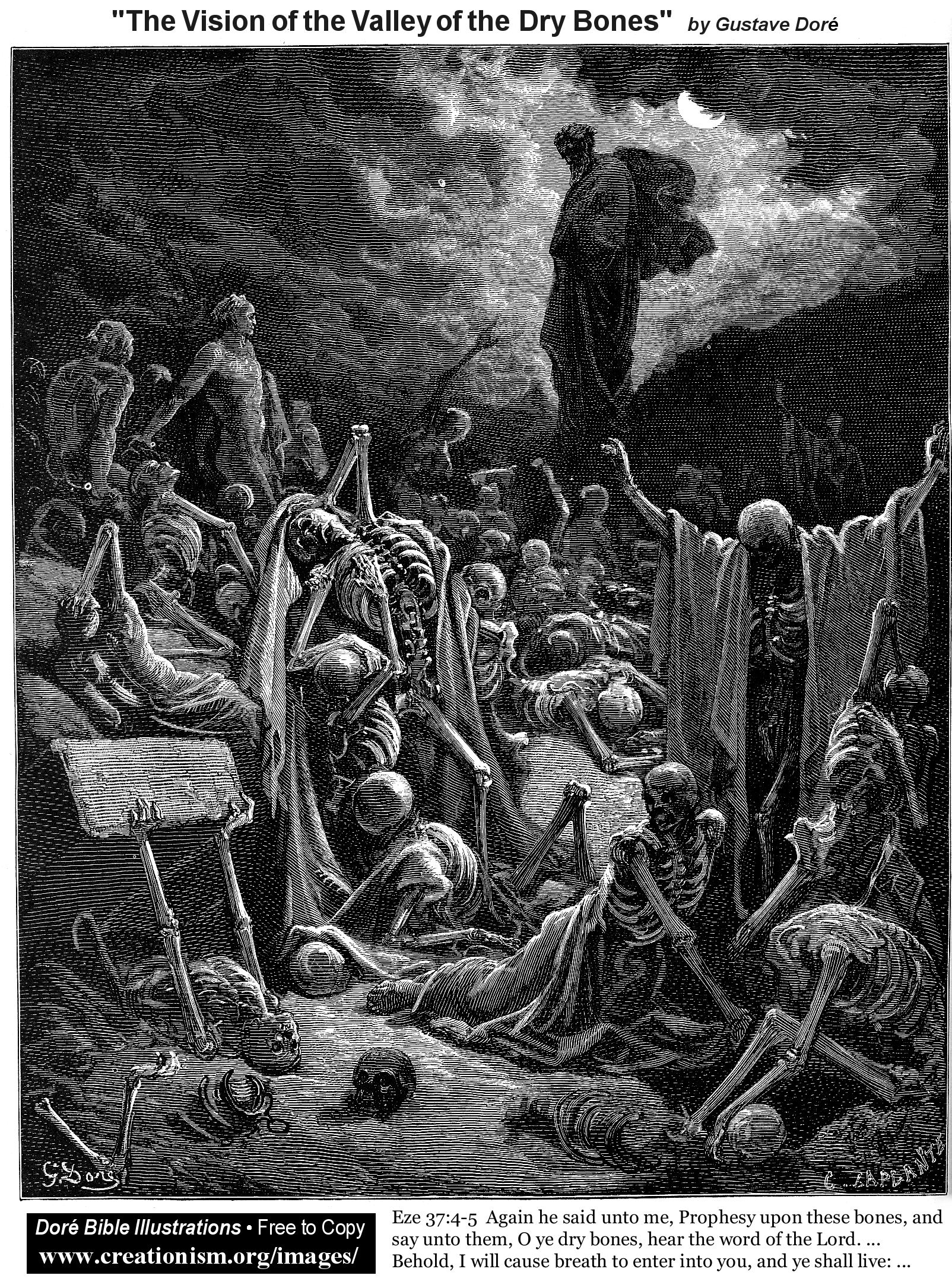
(Painting is of the "Valley of the Dry Bones" - same message!)

Friday, December 29, 2006

What's the Big Deal with Kedusha?

According to the Bais Yaakov of Izbitz on Parshas Vayikra, Kedusha is "hahefech midevarim shel mabakach."

If I want my life to have kedusha, I can't treat even the most "mundane" part of it as a "davar shel mabakach." "Mabakach" means something inconsequential, trivial, or meaningless. I tend to think that certain things I'm doing like eating, working, chopping tomatoes and cucumbers are inconsequential and therefore I don't put any thought or effort, spiritually speaking, into how or why I do them.

But kedusha means treating everything I do like a big deal. Rav Kook says that small people do even big things with "smallness." But big people (Gedolim) do even small things with bigness (gadlus).

So make every moment big!

-Dixie Yid

Thursday, December 28, 2006

Mei Hashiloach on Parshas Vayigash

I've heard various answers to the following question: Why does Yehuda seem to be offering up all of the brothers including Binyomin at the end of parshas Mikeitz as slaves to Mitzrayim, never to return to their father, Yaakov, and yet at the beginning of this week's parsha, he argues vociferously that Binyomin must go back to their father Yaakov, lest his life be in danger? Which is it? Is it okay if Binyomin stays in Mitzrayim as a slave with his brothers, like Yehuda argues at the end of last week's parsha? Or is it intolerable that Binyomin not return to his father, like at the beginning of Vayigash?

Rav Mordechai Yosef from Izbitz writes, in the Mei Hashiloach, that the reason for the difference between these two stances by Yehuda is that he had basically given up on himself and his brothers at the end of last week's parsha. He offered them all up as slaves to Mitzrayim, and he'd given up on all of them. But Rav Mordechai Yosef says that we must know, just like Yehuda realized moments after he'd given up hope, that no matter how undeserving we feel of Hashem's salvation from our problems, He will save us even from that place. So Yehuda strengthened himself by saying, "Even though I did something not right [by offering myself and my brothers as slaves], it's still in Hashem's power to save me." That's what he was doing in his "Vayigash eilav Yehuda."

It doesn't matter that you or I have already made many mistakes. We may feel that we are no longer deserving of Hashem's intervention in our problems at this point. Rav Mordechai Yosef is teaching us that this isn't true. Hashem wants to hear from us, and wants us to pull ourselves up by our bootstraps, as Yehuda did, and turn to and daven to Hashem for a yeshua.

-Dixie Yid