Showing posts with label Yerida v. Aliya. Show all posts

Sunday, December 29, 2013

Guest Post - Serving Hashem with a Broken Heart - Poetry and Pain

I am happy to share the following guest post which was written a couple of weeks ago by a reader who would like to remain anonymous. This is a beautiful, sad, and heartfelt essay that grapples with applying teachings of Breslov and Piaczezna chassidus to real-life challenges and pain. You can read about some of the background concepts that underlie this piece in some of my past posts, like this one discussing the soul's basic need for sensation, any sensation. And also this post and this follow-up one discussing the fundamental reality that one must first destroy the old in order to build something new and greater in its place.

One mans search for meaning in a broken heart
 
“The worst feeling in the world is no feeling at all. A prisoner to passivity, the lacking of connectivity.
Longing to escape this monotonous place, with hopes of arriving at an elated state.
The only thing I feel is the shower drip, the burning hot is quite a trip
With a weak attempt to clear off the dirt, I really just want to know I can still hurt
As the burning hot water leaves its mark
 I only wish my  soul would feel it and spark
In most it flickers while mine just dwindles, hoping for something to help it rekindle
Created to fight and destined to slumber I wish I could cry as my innards continue to dissemble”
A short while ago, the girl I was dating broke up with me. The pain was pretty overwhelming. I couldn’t eat, read, concentrate, converse with people, the very state of being conscious was just too painful. How could one put in to words the pain of losing such a large part of who they were and what they invested in? The echoes from a recently hollowed space in my heart reverberated throughout my soul. It made me greatly question the value of dating and marriage. Why should I risk the potential mind numbing pain that accompanies such heartache? 
The soul is often compared to a candle. A candles flame dances and sways as it flickers in the darkness. So to the soul, its natural state being one of turmoil. The soul has a need to love, feel, and experience. When we are exposed to pain, we instinctually hide that pain behind a veil of cynicism and denial. With this veil draped over our senses, we not only numb ourselves to the pain, but we also hinder our potential to feel joy.
We must understand that every yeridah and aliyah is just another beautiful note on the musical scale of life. Its imperative to remember that every time we trip or stumble, its really just a beautiful melody or dance move in disguise. Our job isn’t to deny and hide the fact that we're struggling but its rather to show the world the potential beauty that lies within that struggle. The beautiful reality that every yeridah brings about the possibility of an even greater aliyah.
The story of the redemption of the Jewish people is always preceded by darkness. The night proceeds the day in the Jewish religion, but we know that the first thought of G-D was the last act in creation. Which means G-d only created the darkness in order to make the light that much greater and magnificent. 
Emunah isn’t ignoring our feelings of despair. Emunah means I have the realization that this pain is very real and deep, but at the same time understanding its an essential experience in the process of creating the new and much improved self. We must acknowledge the heartache, embrace the pain, and mold our experiences in to something meaningful. Life is a constant search for that spark of goodness that’s hidden within the paralyzing darkness.
So yes, I could choose complacency, a life that’s numb to the calling and searching of my soul for its greater half. But wouldn’t I be missing out on the beauty of this world? Because life is not just an assortment of joyous occasions that are arbitrarily strung together. The beauty of growth lies within the ebb and flow of life’s waves, navigated by the souls longing to feel. The lows experienced during this voyage of creating oneself are just as essential as the highs.

So that’s why its worth it. Its worth putting it all on the line again because in the end of the day its really the only option we have. A life without feeling is barely a life at all. And a loving heart that’s never been broken doesn’t really know what it means to love.


We must have faith in G-d, our self, and others. We must not be afraid to share our feelings and struggles with those who are close to us. A Jew must never forget that when all else fails, the gates of tears are never closed.  Although the world tells us it’s a sign of weakness to cry, in reality it’s precisely the opposite. And those who never cry, will never truly experience what it means to laugh. So cry, cry because your entitled to. Cry because it will help you. Cry now because soon you will be laughing. A laughter that will be so great it will fill your mouth. A laughter that will only be as strong and meaningful as your tears had previously been. So lets stand up, light the candle, and spread the light of the broken hearted.

 Click here to get Dixie Yid in your e-mail Inbox or here to "follow" me on Twitter.

Tuesday, September 10, 2013

Video Mashal Illustrating that One Must Destory in Order to Build - The Seed and the Tree


This is a great video by Rabbi Shais Taub and Sruli Broocker illustrating the concept of (i) yerida l'tzorech aliya, descent for the purpose of ascent (ii) stira al m'nas livnos, destroying/disassembling in order to build; (iii) the nahar dinor, the river of fire, through which tzadikim must pass in the world above to ascend from lower Gan Eden to upper Gan Eden; and (iv) many other fundamental concepts underlying the structure of the world and life. Big thumbs up!!! HT Jew in the City.
 
I wrote about the concept underlying this video as well here, here, and here. Enjoy!
 
Click here to get Dixie Yid in your e-mail Inbox or here to "follow" me on Twitter.

Friday, October 30, 2009

Upgrading From Manischewitz to Dom Perignon

If you have a cup of Manischewitz and you want to upgrade to a cup of Dom Perignon. You can't just add the Dom Perignon to the Manischewitz. If you do, then you don't really have Dom Perignon. You'd just have a corrupted mixture of Dom Perignon and Manischewitz. The Manischewitz may be good on a certain level. But if you want Dom Perignon, you have to pour out the old wine completely and wash out the cup. It may hurt to "waste" the lower wine, but the only way to have a pure cup of Dom Perignon is by purging the cup of the lower quality wine first.

This idea connects to a story that I just received from a reader about his meeting this week with the mekubal, Rav David Chaninia Pinto:
Have you heard of Rav David Chanania Pinto? He's fairly well know with the Sephardic/M'kubal community. He's also, it seems, know as a Baal Mussar (his father learned in the Novardok Yeshiva)...

He asked if I had given my wife a watch. I did give her a watch when we got engaged and I got her another one about a year ago. My wife mentioned to the Rav that both of them were broken. He said "If it is broken, then it's as if you have nothing". Fairly profound mussar, if you ask me. I was a bit overwhelmed, but was able to speak with him on the phone yesterday.

I asked him about what he said regarding "if it's broken, it's as if you have nothing" in contrast to the teaching of Reb Nachman "If you believe you can damage, believe you can fix". He said that "if you do not have the skills to fix a watch, then really have nothing". If you can't fix something then you need to start from the beginning...

I wish I could write that "I don't know what to make of it", but the truth is that it's what I needed to hear.
See also:

One Must Destory in Order to Build
One Must Destory in Order to Build Part II

Picture courtesy of just-glass-online.com. Click here to get Dixie Yid in your e-mail Inbox or here to subscribe in Google Reader.

Thursday, August 7, 2008

He Guides Us Like Children - Learning to Make It On Our Own


The Toldos Yaakov Yosef has a teaching at the beginnig of Parshas Maasei that really reflects my experience over time from intially becoming religious until now.

He's addressing the question, "How could it be that all Jewish people experienced the highest levels of Nevuah, prophecy and relelation, immediately after Yetzias Mitzrayim when they will weren't terribly distinguishable from the Egyptians? How could they experience levels of prophecy as great as Yechezkel Hanavi even while awake, when the Torah later says that only Moshe Rebbeinu merited such a level?"

He essentially answers that Hashem, at the beginning of our nation's existance as sevants of G-d, temporarily just handed us a great spiritual level without any real work or attainment on our part. He just wanted us to understand what kind of level a human being who serves G-d is capable of attaining so that we would know what our goal should be for the future. We then had to work, step by step, slowly but surely, back up to that level through the 49 days of the sefirah, up to Har Sinai, where we, again received the full relevalation of Hashem because "pasku zuhamasan." However, again, this level was only temporary and we were left on our own to slowly and gradually re-attain those lofty levels that we were initially just handed "for free," to get us hooked, so to speak.

He compares it to how a father initally trains his child to walk by holding the child's hand and helping the child walk at first. But at a certain point, the father withdraws his help so that the child can learn to walk on his/her own. (I can relate to this as well since we're almost up to this with our youngest daughter who was born just over a year ago.) The child will fall a few times, but this is necessary so that they child will learn to attain that skill on her own.

I can certainly relate to this. When I was first becoming religious, I was able to make huge strides in my mitzvah observance with relatively little effort. At one point, for instance, I had just read The World of the Yeshiva and Tradition in a Rootless World: Women Turn to Orthodox Judaism, two books which weren't meant to be so positive towards Frumkeit. Reading more about the orthodox life though, made me realize that I would be terribly stunted in my growth if I didn't start keeping "shomer negiah" and "kol isha," i.e. abstaining from physical contact with women and not listening to women singing. So in a very short period of time, while still in high school, I gave those things up. It wasn't a total breeze, but compared to the improvements I try to engage in now, it was much easier.

I definitely feel like for those first couple of years, Hashem was holding my hand and just leading me along the path till I got to a point where I could stay basically religious on my own. However, after those early stages, I feel like he said to me, "My dearest Yid from Dixie, it is time for me to let go now. If you want to keep growing closer to me, you're going to have to do it on your own now." It's a sad transition, but it is obviously the whole purpose of why we are created; to attain closeness with G-d through our own efforts, sacrifices & hishtadlus.

May Hashem help us attain the highest levels even after He has let go of our hands and expexts us to do it on our own. And may He continue to give us little nudges in the right direction!

-Dixie Yid

(Picture courtesy of timbarcz)

Click here to get Dixie Yid in your e-mail Inbox.

Monday, June 23, 2008

Being Happy When Bad Things Happen to You - Q&A at ASJ


A Simple Jew has posted an answer that I wrote to the question that I'm quoting below. I discussed a personal experience that's relevant to the question and a couple of insights that I was thinking about into some relevant gemaras. Here's his question:

A Simple Jew asks:

It has been taught that sincerely thanking Hashem for the obstacles and the daily problems we encounter helps to sweeten the harsh judgements against us.
Has there ever been an occasion in your life where you felt as if you were caught in the middle of a storm and instead of despairing you stopped and thanked Hashem for that very storm?

Dixie Yid Answers...

-Dixie Yid

(Picture courtesy of abstractica)

Click here to get Dixie Yid in your e-mail Inbox.

Monday, June 16, 2008

The Gaps That Bring One Closer - R' Binyomin's Drasha From Shavuos


On the second night of Shavuos, between Mincha and Ma'ariv, Kehillas Aish Kodesh was zoche to have Rabbi Binyomin Tepfer, a Rebbe at HAFTR and a son-in-law of Rav Weinberger, give the Drasha. It was a great message that is relevant to how each of us approaches the challenges and obstacles to growth in ruchnius that we face on a day-to-day basis. IY"H, I hope to briefly summarize what he said here, though obviously I can't capture the delivery or all of the detail in a one hour Drasha. I also want to thank Rabbi Tepfer for clarifying a few points from the drasha as well.

The Setup

Rabbi Tepfer introduced three sugyos where one finds the concept of a "Retzuah," a strip of some sort, which separates between the holy and the mundane, to which Chazal have an ambivalent relationship.

#1 The Gemara in Chagiga 25a teaches the din that if one brings wine or oil for the Beis Hamikdash from Yehuda (Judea), it is Tahor. But that if it is brought from the Galil, it is Tamei. "ביהודה אין ובגליל לא מ"ט אמר ריש לקיש מפני שרצועה של כותים מפסקת ביניהן." The Gemara asks, "In Yehuda, yes [it's tahor (pure)]. But in the Galil, no [it's not pure]. Reish Lakish says that this is because there is a strip (Retzuah) of gentiles which separates between them." Rashi there explains that since Kusim live in that strip of land, it has the din (status) of Chutz La'Aretz (being outside of Israel). He further explains that the Chachamim instituted a Tuma D'rabanan (rabbinically insituted impurity) on any wine or oil passing through Chutz La'Aretz. Therefore, wine or oil that will be brought through that strip from the Galil will be Tamei. However, Rebbeinu Chananel said that the Retzuah actually was part of Eretz Yisroel, but that because mostly gentiles lived their, the Chachamim were gozer (insituted) the Tuma status because graves and the like were not clearly marked there.

However, Tosafos ask another question. How were the people from the Galil who had to pass through this Retzuah/strip able to be oleh l'regel (make the pilgrimige to the Beis Hamikdash) three times a year? To offer the Korbanos, they would have to go through a 7 day purification process, which would add a week to their trip every single time! This seems so impractical. Why would Hashem set up this michshol, stumbling block, before people, by creating this disincentive to be oleh l'regel? R' Tepfer also asked what the meaning of the machlokes is, wherein Rashi holds that this Retzuah, cutting right accross Eretz Yisroel from East to West does not even have the status of E"Y, but that Rabeinu Chananel holds that it is indeed considered part of E"Y...

#2 We are told the following by the Gemara in Zevachim 53b-54a: "וקרן מזרחית דרומית לא היה לה יסוד מ"ט? ... אמר רבי חמא ברבי חנינא רצועה היתה יוצאה מחלקו של יהודה ונכנסה בחלקו של בנימין והיה בנימין הצדיק מצטער עליה בכל יום לנוטלה שנאמר(דברים לג) חופף עליו כל היום לפיכך זכה בנימין הצדיק ונעשה אושפיזכן להקב"ה שנאמר (דברים לג) ובין כתפיו שכן." "The south-eastern corner [of the Mizbeach/Alter] had no foundation (Yesod). Why? ... Rabi Chama, in the name of Rabi Chanina, taught: There was a Retzuah/strip [of land] coming out of the portion of Yehuda['s land] and entering the portion of [the tribe of] Binyamin. And the Tzadik Binyamin was pained by this every day, that it had been taken, as it says [in Devarim 33:12) 'He hovered over it all day.' Therefore, the Tzadik Binyamin merited to become the host for the Holy One, as it is written (Id.), "And between his [Binyamin's] shoulders it [the Kodesh Hakodoshim] will rest."

We see here another example of a "pesky" strip which gets in the way of the Tzadik Binyamin's feeling of wholeness in his portion in the Eretz Hakodesh, the holy land. First, we had the Retzuah of land creating Tuma/impurity problems for the residents of the Galil who wanted to be oleh l'regel, and now we find a tiny strip of land from Shevet Yehuda taking away what should have been part of Binyamin's portion, to the point where it prevents part of the Mizbeach from having a "Yesod," a foundation!

#3 With regard to whether or not the the Retzuos (strips) of the tefillin are truly part of the tefillin or not, there is a machlokes between the Mechaber and the Rama in the Shulchan Aruch Orach Chaim 33:4 (page 59 in the linked pdf file). The Mechaber holds that the Retzuos do not need to be colored lishmah (for the sake of the mitzva of tefillin) and they are kosher bidieved if colored by an Eino Yehudi, a gentile. This is the same din as the actual teffilin themselves. Therefore, the Mechaber holds that the Retzuos are of the same status as the actual tefillin. Whereas the Rema holds that the Retzuos, the straps, must be colored lishma, unlike the actual tefillin themselves. This implies that they are not part of the tefillin themselves and that is why they have a different din than the actual teffilin.

Finding the Common Denominator

Rabbi Tepfer suggested the following common denominator in all of these sugyos relating to Retzuos: In all three cases, there is some interrupting separation between one's desire to connect to kedusha. In all three cases, that sepperator appears outwardly to be a lowly and mundane obstacle to holiness. But in each case, that obstacle was eventually shown to be the instigator for greater holiness.

#1 The Retzuah of Tuma that separated the residents of the Gailil from the Beis Hamikdash seemed outwardly like it wasn't even part of Eretz Yisroel (Rashi). But Rebeinu Chananel showed how even though it appeared unholy because of the kind of people living there, b'pnimius, deep inside, it really was still Eretz Yisroel. Also, that Retzuah which sepperated them from Yerushalayim and aliya l'regel ended up causing them to spend an extra week in Yerushalayim three times a year in preperation for Pesach, Shavuos and Sukkos. In all liklihood, this probably caused them to be even more influenced by holiness than people from other parts of E"Y who came to Yerushalayim only a very short time before the Chag. Also, he suggested that Hashem caused this challenge/opportunity to fall in the lap of the Galil residents because they (who live in Tzfas, Meiron, Tiveria, etc.) were more attuned to how Hashem causes aliyos (growth) to come to people through yeridos (problems).

#2 Binyamin felt that that this little Retzuah of land from Yehuda was taking away from the completeness of his kinyan, his ownership and connection to the holy land. Also, Binyamin was the brother of Yosef, the Tzadik Yesod Olam, the foundation of the world. But since he did not have the portion of E"Y at the point of the south-eastern corner of the Mizbeach/Alter, that point lacked a Yesod, foundation since it lacked that connection to the Tzadik Yesod Olam. However, it was davka (specifically) because he was so bothered by wanting to have an even more complete portion in Eretz Yisroel that Hashem responded by decreeing that he would be zocheh to have the Kodesh Hakodoshim, the Holy of Holies, housed on his territory. Through his feeling of the incompleteness of his avodah, he was zoche to have so much more than he would have had, had he felt complete in his avodas Hashem, without that Retzuah standing in the way.

#3 According to the Shulchan Aruch, who holds that Retzuos (tefillin straps) do not need to be colored lishmah, just like the Batim, the Retzuos are part of the Tefillin. According to the Yam HaChochma on that se'if in Shulchan Aruch (33:4, year 5767), the Mechaber holds that the Retzuos are the essence of Bina, just as the Batim are, and therefore neither require coloring for the sake of the mitvah. They are already the essence of Bina and don't require coloring lishma. Therefore, the Retzuos are part of the tefillin. However, the Rema holds that the Retzuos are not the essence of Bina, unlike the Batim, and therefore must be colored lishma. The Mechaber, however, who shows the influence of Kabbalah throughout Shulchan Aruch, is more in tune with the side of Bina, and therefore he is more inclined to see how the outwardly non-tefilin status of the Retzuos hide within it a deeper reality, wherein the Retzuos have the same kedusha status as the tefillin themselves. He doesn't view them as a sepperation between the person and the kedusha of the tefillin. rather, they are just as holy in that they are the medium through which one can access kedusha.

The common denominator in all of these cases, which is the same one that we can see in our daily lives, is that the things which stand in our way of achieving the levels in holiness that we know we should reach, are there just to make us want it more. That feeling of incompleteness, of wanting more but not getting it, is the source for so much more growth in Avodas Hashem than immediate success in avodas Hashem would have accomplished.

-Dixie Yid

(Picture courtesy of Yitzi Mayer)

Click here to get Dixie Yid in your e-mail Inbox.

Monday, April 28, 2008

Our Escapist Tendencies - Getting to Know Yourself


I have written before about people's desire to distract themselves from their own desire for greater holiness and their dissatisfaction with their life without it. I wrote about wanting to distract one's self from Shabbos and from one's spiritual life in general, using movies/TV/ipods/novels/etc here and here.

This is expresed also in the way that the priests used to sacrifice people's children to the Molech. While the priests would kill their children, other priests would beat drums and play loud music, so that people should not hear the screaming of their children calling out for their help, which might cause them to change their mind about what they were doing.

Similarly, when our neshamos are crying out to us for help, we don't like the discomfort of hearing that inner pain. So we distract ourselves from hearing our inner voice by drowning it out with ipod music, movies, novels, or workaholic-ism.

If we want to take the first step towards living the life we are supposed to live, rather than distracting ourselves from that purpose with all of our twenty-first century distractions, then we must first recognize that we do not need all of our gadgets and distractsions merely for their enjoyment or necessity. Rather, we must recognize that, to the extent that this is the case, they are really there to drown out the voice of our neshamos.

Once we attain this self-recognition, we can begin to do a kind of hisbonenus before we begin to engage in one of these entertaining distractions. One might say to himself before opening up a novel or turning on his ipod during a train or bus ride: "The true inner "I," my neshoma, wants to serve you, Hashem. But the superficial "I" doesn't want to think about things like that. I don't feel that I have the wherewithall to win in this battle right now, so I am going to do XYZ to take my mind off of what I should really being doing right now. But I recognize that it is only a distraction, and not the deeper desire of who I truly am inside."

This brief thought is, IMHO, in line with the teachings of the Bilvavi Mishkan Evneh. IY"H, may we merit to recognize our escapist tendencies and get to truly know ourselves, as a first step towards "getting to know" Hashem.

-Dixie Yid

Click here to get Dixie Yid in your e-mail Inbox.

Friday, March 28, 2008

Great Reader Comment on Handling a Loss of Motivation


I received the following anonymous comment here from a reader on what I wrote in my Q&A session with A Simple Jew regarding how to deal with a lack of motivation. Below the comment is my response as well.

I have a hard time saying that self-motivation is not from self but totally from Hashem. Bechira? Hakol b'yedai Shamayim chutz m'yiras Shamayim? Learning is certainly part of yiras shamayim. Sure, we thank Hashem for helping us and inspiring us but there's still bechira and an us.

I think the best way to handle your matzav is this:

Whenever I share the following insight with others, they seemed shocked by it. Here’s the insight: we as human beings are not designed to serve the Ribbono Shel Olam with constant enthusiasm and joy. In fact, it is quite normal and natural to have days when we serve Him that would be classified as ‘yemai sinah-days of hate.’ Days of hate?! Yes, you read that correctly. [This is explained in detail in Alei Shur, Volume 1, pgs. 34-35, based on the Sefer HaYashar (attributed to Rabbeinu Tam).]Rav Wolbe, ztl tells us that we all experience times of aliyah, when we are super excited and energized with our davening, learning, chesed and general mitzvah fulfillment, but all of us also experience periods of yeridah, when we are ‘just aren’t into it’, when we drag our feet in our avodas Hashem. This is the normative cycle. When the times of yeridah occur, the instinctive tendency is for us to feel like ‘we failed again.’ We ‘beat ourselves up’ with thoughts of ‘I guess my avodas Hashem can never be on high level. If I can’t be consistent then I’m probably not real with it. I might as well give up on my high hopes and dreams and set my sights on a low level intensity of avodas Hashem.’ And this is where we make our colossal mistake, says Rav Wolbe. The key for long lasting spiritual growth is to recognize and accept the fact of life that there are indeed going to be yemai ahavah, when we will feel great love for the Ribbono Shel Olam and His Torah, but there are also going to be days of hate, yemai sinah, when we just aren’t ‘in the mood’. The goal is to try to maximize the yemai ahavah, to maintain them for as long as possible, and to reduce and minimize the yemai sinah. How should we handle ourselves when we find we are in the ‘days of hate’ mode? Rav Wolbe tells us the ‘way out’ of ‘yemai sinah’ is to make sure not to lose hope and be ‘meya’aish’. We must not give up our avodah entirely, not to resolve to stop whatever we were working on. As the Kotzker Rebbe said in a play on words from a famous sugya in the gemara, ‘Yeush? Shelo Midaas!’, Losing hope? That’s a lack of intelligence! The proper way to deal with ‘days of hate’ is to go easy on ourselves somewhat, to lighten the load, but to still hold on to some aspect of what we were doing. If we had resolved to learn 4 hours a day and we find ourselves in a rut, unable to accomplish this, then we still must learn that day as much as possible, but intentionally less than our original goal. And so on for all areas of growth.

If we properly handle ourselves during the yemai sinah, then we will be able to get back to our grander goals that we set for ourselves when yemai ahavah come. But if we ‘crash and burn’ during yemai sinah, all of our spiritual goals will be lost.This same idea is expressed sharply and succinctly by the Kotzker Rebbe (see Yalkut Maishiv Nefesh, page 129). We say in the Shema every day, that we must love Hashem with our entire life, bechol nafshecha, and Chazal say that this means even if Hashem takes our life away, even if we must die for Hashem. The same should follow, says the Kotzker, regarding the words bechol levavecha, that we must love Hashem with our entire heart, and we should extend the same Chazal, even if Hashem takes away our heart. Even if our inspiration to serve Him dwindles or is removed, even if we don’t presently have the passion to serve Him with the enthusiasm that we once possessed, we must still serve Him nonetheless. The Yalkut Maishiv Nefesh (pgs. 124-125) quotes the same concept from Rav Chaim Volozhin in the Ruach Chaim on Avos: “A person is constantly going up and down (in ruchniyus). When he’s down, he feels as if whatever he does and has done in avodas Hashem was without a full heart, and he’s not accomplishing anything by doing it. He wants to rest and sleep deeply until the time of passionate avodas Hashem would return...

But a person can grow easily to a high level if he specifically maintains his avodah, even when feeling a weakening, a hisrashlus, rather than entirely giving up his service. If he gives up his avodah entirely (until he feels the passion again), he’ll distance himself further. . .’ Rav Chaim Shmulevitz (Sichas Mussar, 5732, Maamar 37) also states this insight into spiritual growth. The pasuk in Micha (7:8) says ‘Al tismechu ayvati lee, kee nafalti kamti, kee eshev b’choshech, Hashem or li-My enemies should not rejoice that I have fallen, because I have gotten up; when I sat in darkness, Hashem was a light for me.’ Chazal darshin and explain the pasuk as follows: that if I had not fallen, I would not have risen-ilu lo nafalti, lo kamti—I have only grown because I fell in avodas Hashem. I have only experienced Hashem as a light for me because I once did experience the darkness, the lack of spiritual growth.

And this: R’ Akiva Tatz in Living Inspired describes based on R’ Tzadok that the natural experience in life is that after we become inspired about something, the inspiration fades. We are incapable of maintaining the newness of any experience. Any true growth in Torah requires the following three step process:

1. A person is inspired artificially at the beginning of any phase of life,
2. Hashem removes the inspiration so that we work on acquiring a true connection to the issue which inspired us. In this stage, there is a danger that we will give up and fail to maintain the growth we did seek,
3. The challenge to fight back to the point of inspiration, and in doing so, to build it permanently into our character.

R’ Tatz writes: “Unfortunately, most people do not know this secret. We are misled into thinking that the world is supposed to be a constant thrill and we feel only half-alive because it is not.”


Anon,

Thank you very very much for your extremely thoughtful comment.

Regarding your first point, of course it makes sense that "self" motivation comes from Hashem and not from ourselves. And it's davka from the ma'amar of "hakol biydei shamayim chutz miyiras Shamayim." Our inner wellspring of inspiration and natural motivation is outside the scope of "yiras shamayaim." It's something we *find* within, not create ourselves. We may sometimes do something despite the fact that we are not motivated to do so because we know it is the right thing, but the motivation its self is a gift from Hashem, like all kochos hanefesh that we are given by Hashem.

Regarding everything else that you said, it's great advice and well worth sharing. You might also like to see what I've written on the subject HERE. It's actually one of the first things that I wrote. Again, I'm going to have to re-read and think more about what you've written.

-Dixie Yid

(Picture courtesy of patrick.net)

Click here to get Dixie Yid in your e-mail Inbox.

Thursday, March 27, 2008

What to Do When You Lose Your "Self-Motivation"


Click on over to A Simple Jew for our latest Q&A session. Here's ASJ's question and you can follow the link to see my answer.

A Simple Jew asks:

In our e-mail correspondence you indicated that you too have experienced the "lego castle phenomenon" in regards to your learning. After the thrill of starting something new slowly wears off have you found it to be difficult to maintain a daily learning regimen?

Dixie Yid Answers...

-Dixie Yid

(Picture courtesy of Shuvu Bonim.org)

Click here to get Dixie Yid in your e-mail Inbox.

Wednesday, March 26, 2008

Reb Tzadok: The Area of Our Greatest Weakness is the Area of Our Greatest Strength


Rav Tzadok Hakohen, in Tzidkus Hatzadik #70, says that the area of one's biggest failings is davka the area of his biggest greatness, and through davka that thing, he will reach very high levels.

He says that the Gemara in Sanhedrin 70a says that "שבדבר שקלקלו בו נתקנו," "in the area in which one has sined, through that area he will be mesukan [repaired]."

This is also why the Gemara says, in Yershalmi Brachos 2:4, that "ביומא דאיתיליד איחרוב בית מוקדשא," that on the day that the Beis Hamikdash was destroyed, Moshiach was born. Rav Tzadok seems to be using this Gemara to say that we see that on the very day of the destruction of the Beis Hamikdosh, which personifies our faults, Moshiach was born. That is to say that from the very faults themselves arise the tikun to those faults, Moshiach Tzidkeinu.

He also says that this is the principal which underlies the statement in the Midrash Raba in Parshas Chukas that the Para Aduma, the Red Heiffer, is davka the atonement for the impurity created by the sin of the Golden Calf, the "idolotry" that was done with a baby heiffer.

It all goes back to the principal that Hashem gives the person his greatest difficulties in a certain area because that is the area in which he has the biggest potential for greatness.

This can be difficult to understand. One could feel that if he takes this advice, then he will put all of his efforts into his area of greatest difficulty in Avodas Hashem. But he could worry that if he does this, then he's just setting himself up for failure when the challenge is too much for him. A person may think that it would be better to put off those big fights and, instead, work on those areas of growth which are easier for him. I definitely think that this is the propper way to go most of the time. The discouragement that can come from failure can do more damage that if the person had just focused on the easier battles.

However, I think that we also have to keep in mind what Rav Tzadok said in Tzidkus Hatzadik #45, about one whose heart has become so closed that Teshuva has been closed off from him. He says that when such a person makes himself humble, and empties himself out until he is like "nothing," then Hashem "creates something from nothing." When a person stops relying on his own "inner strength" to overcome his weakness, that is when the person is ready to realize that it was really Hashem all allong, who gave him the "koach la'asos chayil," the ability to accomplish things in Avodas Hashem. It is only when one makes himself as nothing, that he will be ready to realize that the koach to have his teshuva accepted comes from Hashem and not himself.

May Hashem give us the koach to see our tikun in our area of greatest difficulty and help us be zocheh to true anavah, humility very soon!

-Dixie Yid

(Picture courtesy of Mysterium)

Click here to get Dixie Yid in your e-mail Inbox.

Monday, March 24, 2008

Reb Tzadok on Why One Must Always Revisit the Sins of the Past


Rav Tzadok Hakohen, in Tzidkus Hatzadik #67, says that no matter how high of a level a person reaches, and even though he has done teshuva for his aveiros, he must always revisit his sins.

This idea comes from Tehilim 51:5, where it says "וְחַטָּאתִי נֶגְדִּי תָמִיד," "and my sin is always before me." Even though Hashem has accepted his teshuva completely, he must still recall and do teshuva for his sins. This is because such a person never remains static. One should always be growing and ascending from level to level.

Therefore, one's conduct in this world should reflect that which the Arizal said about life in Gan Eden. He says that every time one ascends to a highter and greater level in Gan Eden, "they" are more particular with him about his aveiros and he is punished for even the smallest sin. I read this to mean that certain things are not a sin at all, and may even be considered mitzovs to one who is on a lower level. However, the same things which may have been fine for a lower level person are far beneath that same person which he reaches a higher level. Therefore, things which weren't sins earlier in his growth become sins which require kapara and teshuva in the world to come.

Similarly in this world, one can cleanse himself of the "new sins" that develop in one's past by continually doing teshuva for things that may not have been a problem before, but become problematic to have in one's "record" as his level becomes higher.

He says this is the reason for "Yerida l'tzorech aliya." When Shamayim becomes medakdeik on a person for aveiros that only become an issue because of the person's aliya, that is called a time of "yerida." One must do teshuva for those things at such a time, and that will be the aliya that was precipitated by the "yerida."

Furthermore, Rav Tzadok writes in #57 that the regret and anguish that one feels because of his aveiros constitutes the literal punishment of Geheinom. That is why the Gemara says in Brachos 12b, "כל העושה דבר עבירה ומתבייש בו מוחלין לו על כל עונותיו," "Anyone who does an aveira and is embarrased because of it, all of his sins are forgiven." Rav Tzadok explains that this is because of the aforementioned principal that Agmas Nefesh, anguish one feels because of his aveiros, literally consitutes Geheinom.

This principal is why one's teshuva for "newfound" aveiros that only become an issue when he becomes greater is effective in getting rid of those daduskideh, subtle, aveiros. Of course, the same principal would ostensibly apply to regular, gasusdikeh, big time, aveiros as well and one should feel regret and anguish about his aveiros. We should know, based on this Tzidkus Hatzadik, that this feeling its self is mechaper for our aveiros.

Baruch Hashem that He gave us so many ways and opportunities to rid ourselves of our shmootz that keeps us away from Him.

-Dixie Yid

(Picture courtesy of stemnet.nf.ca)

Click here to get Dixie Yid in your e-mail Inbox.

Wednesday, February 27, 2008

Should One Foucus on Understanding His Yetzer Hara?


In preperation for this post regarding the yetzer hara, I recently asked Rabbi Micha Golshevsky, the author of the weekly translations of Rav Itchie Mayer Morgenstern's Torahs, the following question:

I remember reading recently, and I can't remember if it was from you, something about not focusing too much on understanding the yetzer hara, even if it is for the good reason of trying to understand it better in order to beat it. Whatever I read said that this could be dangerous because it will just bring you down, despite the good intentions.

I can't remember who i heard/read this from, or what the person's source was. Do you know where this idea is from?


Below is his response to me, collected from several e-mails in our e-conversation:

In terms of your question, virtually all of mussar and much of chasidus is a study of the yetzer hara, meant to insulate and protect us from its insidious methods. For example, it often causes one not to notice the bad tendencies and spiritual weaknesses within. This way we won't even know to do teshuvah. How can you correct a problem you don't know exists? Another method of the yetzer is rationalization. It is even possible to convince one that what is really a sin is a mitzvah in a particular situation.

However, the Ohr Hachaim Hakadosh (in Parshas Achrei Mos, Vayikra, First one in perek 18) says something a little similar to what you wrote. Interestingly Rebbi Nachman says the same thing in Sefer Hamidos, Niuf I #10. He says that you should never get into a claim and counter claim situation (Toen v' nitan) with your tempter. This will make you all the more likely to fail in your challenge, since thinking about it when sorely tempted--even why you should reject it-- evokes the feelings for it from within. Every instant one spends explaining his rejection to the tempter within only serves to weaken his resolve.

Although the Ohr Hachaim Hakadosh and Rebbe Nachman, discuss arayos specifically, it seems to me that "toen v'nitan" will not be helpful in other areas of temptation as well. For example: when a person sees a delectable dish, if he debates with himself whether to take an extra helping this will often cause him to overeat. Immediately afterwards he will bemoan, "There goes my diet." or words to that effect. (Sometimes he will bemoan this before he takes the extra cake!)

One needs to break out of the mochin dikatnus, "forgetfulness" of the bad effects of the indulgence, not debate the tempter. We have all heard about the chain-smoking doctor exhorting others of the dangers of smoking. He knows it's wrong intellectually and can even argue and debate the whys and wherefores but this doesn't help him one bit. When the cigarette "calls him," he lights up.

What will work to overcome a nisayon? Passionate prayer often helps. Another method that works (for me) is to pull out a powerful sefer that discusses the problem, open up to a potent piece and "go with it" by yearning for holiness and purity through the inspiration it affords. Sometimes the only thing that will work is to leave the place of temptation as quickly as possible.

On a deeper level, Rebe Nachman teaches that while one experiences a nisayon one loses one's da'as regarding the test. This is the definition of a nisayon, since if one were to retain da'as there would be no nisayon! Why would anyone overeat if he had true da'as and felt the bad feelings of overeating before indulging?

The time to prepare for a nisayon is beforehand. One method to build tools to enable one to refuse to do what is wrong as quickly as possible is studying the methods of the yezter and preparing counter-strategies. It is well known that the Ba'aley Mussar would say that the Chovos Halevavos understood the yetzer hara very intimately, and study of it enables one to understand and resist the yetzer. The "Chovos Hatalmidim" comes to mind as an example of a Chassidic Sefer that discusses understanding the yetzer and how to resist it at length.

Perhaps you also meant that you need to find the correct time to work on the yetzer since if you work on it immediately after a fall, you can fall to depression. This is illustrated in the following story:

Rav Noach of Lechvitch zt"l once said, "If a Jew succumbs to temptation or manifests a character defect, he must not allow himself to fall into the trap of self-absorbed despondency, but must do teshuvah instead.

"This could be compared to two servants of the king who were sent to war, one wise and the other foolish. During the battle, the wise one took a hit, but he decided that the middle of a battlefield is no place to attend to a minor wound. The foolish servant also sustained a minor injury, but he decided to immediately attend to it. He stopped shooting, became an easy target, and was killed immediately.

"Similarly, one who sustains a 'flesh wound' while fighting his inclination could easy fall into depression. But this will destroy his ability to focus on prayer or Torah study, his main weapons in the war! This leaves him completely vulnerable. Every soul is rooted in the olam hata'anug, the supernal world of delight, and anyone who does not feel pleasure in serving Hashem is automatically drawn after material pleasures. The only solution is to immediately change direction by doing teshuvah. This simply means resolving not to do the sin again!"

Rav Nosson discusses at great length a concept first brought in the Ramban in Iyov. Iyov said, "I feared a fear and it came upon me." This teaches a very profound lesson: one who fears literally draws this into one's life. One who focuses on the good and kindnesses in his life will draw even more kindness into his life. The mind is very powerful and the power of visualization is well documented. What we think affects us and those around us. We must think good, positive thoughts and forget the difficulties in our lives. It is enough to deal with them as they crop up. Let us remember the famous Chassidic adage: "Where your mind is, that is where you are!"

Hashem should help us overcome our unique spiritual challenges, each person in his own way!


-Dixie Yid

(Picture courtesy of rome's world)

Click here to get Dixie Yid in your e-mail Inbox.

Monday, February 4, 2008

When Hashem Reminds Us We Need to Do Teshuva in Extreem Ways


In Parshas Mishpatim, regarding the law of the unintential murderer, who is punished with exile in the Ir Hamiklat, the Mei Hashiloach, Rav Mordechai Yosef of Izbitz gives us a new perspective on Rashi's pshat there. In Shmos 21:13, on the pasuk, "וְהָאֱלֹקֵים אִנָּה לְיָדוֹ," "and Hashem caused it to happen to him," Rashi explains why Hashem set it up for this person to accidently kill someone else. He says that the one who killed accidently had killed accidently anohter time, but was never caught and therefore never got the opportunity to atone by enduring the punishment of exile. So Hashem makes it so that he will kill accidently now and go into exile. The one who was killed had previously committed intential murder, but there was not enough proof to execute him, so Hashem causes him to be killed accidently this time, so that he gets his just deserts.

But the Mei Hashiloach asks the famous question; "If Hashem made the the accidental murderer kill this time because he'd already killed accidently another time without being caught, then how did Hashem let it happen that time?!" He answers by connecting our story here to a pasuk in Tehillim 145:14, "סוֹמֵךְ ה' לְכָל-הַנֹּפְלִים וְזוֹקֵף, לְכָל-הַכְּפוּפִים," "Hashem supports the fallen and straightens the bent." He says that "the fallen," refers to those who have the mida, the trait, of anger, and who have acted on that trait and committed murder. Hashem supports that kind of person by giving them the kapara, the atonement, he needs, though being killed by the negligent murderer.

And he says that the accidental murder is being referred to as one of those who are "כְּפוּפִים," "bent." He says that the accidental murderer, who Rashi says killed b'shogeg, accidently, before, did not literally kill anyone. Rather, it refers to those who have the mida of anger, ka'as, but do not act out on it. However, they are bent under the weight of this bad mida that they are not willing or able to get rid of. Like a monkey on his back, his bad mida causes him to be bent under it, though he doesn't actually act out on it. Hashem, however, does not want to leave anyone in a bad matzav forever. So he decides to jolt the person out of his apathy and causes him to kill another person accidently. This jarring experience is the catalyst for the person to finally do teshuva.

We know that the Torah's teachings apply equally in all generations, and even this Rashi and pasuk about the law of accidental murderers has something to teach us. Today, a person may also have a bad trait or "low-level aveira" that he does on an on-going basis. But this does not appear serious enough in his eyes to bring his guilt level to more more than a slow throb. So he continues living with it month after month and year after year. However, at some point, he may hits a point where he goes further and deeper into that aveira than he ever thought possible. The depths to which he has sunk finally brings home, to him, how those "low-level" aveiros or bad midos he did nothing to break, had a lot bigger effect that he acknowledged. This is the chance for the person to finally do something about that long-time problem and do teshuva.

May we merit to realize our faults before they get out of hand and do teshuva early, so Hashem does not need to bring home its necessity using extreme measures!

-Dixie Yid

(Picture courtesy of liberry.blogspot.com)

Click here to get Dixie Yid in your e-mail Inbox.

Thursday, January 24, 2008

Why Serving Hashem is Not Like Fulfilling Other Ta'avos/Desires


I opened up the Meor Einayim on Parshas Yisro and right at the beginning of the parsha (SLAM!) he hits me with a powerful yesod that goes to the essence of the difficulty in keeping up my resolve in avodas Hashem.

He asked what the big secret of "Na'aseh v'nishma," "We will do and we will hear," is, such that the Midrash says about it, "The angels asked, 'who revealed this secret, which is used by ministering angels?'"

He said that the way Hashem made the world is that first we must do tircha (toil) and avoda (work) in avodas Hashem. The next step after that is the pleasure of the Divine light from that avodas Hashem. He says that if we felt the true ta'anug from avodas Hashem while we were doing those mitzovs and abstaining from those aveiros, then we would serve Hashem to fulfill a ta'ava, a desire, just like we try to fulfill any other ta'ava.

However, after one does the avodas Hashem for a while, he does receve the ta'anug, the pleasure, from that avodas Hashem even in this life. That is what is called, "Olam Haboh," the "Coming World." It is called that because it refers to our worldy pleasure from serving Hashem. That pleasure is continually "coming" to us after a period of serving Hashem without that feeling of pleasure. In contrast, "Asid Lavoh," the "Future world" refers to the pleasures of the next world, as distinguished from the Divine pleasure that we can feel in this world.

This seems to me to be the hardest part of keeping up my resolve in growing in avodas Hashem. There seems to be such a lag time between the investment and the results! And I feel from reading this piece in the Meor Einayim that just when I usually give up is the moment right before I'm about to scale the crest of that mountain.

We have to be mechazeik ourselves not to give up during the "dry period" before the Divine pleasure from our avodas Hashem kicks in. But rather, we must know that it is coming, and that the fact that the gratification is not instant is what makes avodas Hashem into actual service of Hashem, rather than merely a way of serving ourselves.

-Dixie Yid

(Picture courtesy of loc.gov)

Click here to get Dixie Yid in your e-mail Inbox.

Tuesday, January 22, 2008

When the Soul's Pressure Makes the Heart Want to Explode


Rav Kook in Oros Hateshuva 15:4 talks about the bitterness the soul feels when the life of the person in whom it is trapped, does not give the soul it's powerful, true and full expression. He says that the soul contains (much like an atom) a tremendous amount of power. It desires to channel that power into an explosion of holiness and avodas Hashem.

When don't give it that expression, but rather only try to passify that inner pressing against the heart through shallow means, after time the pressure on the heart only continues to get even stronger. My Rebbe explained that when the energy is merely channeled into a new job, going back to school, a new hobby, a new car, a new girlfriend, a new blog, or whatever other type of emptiness, then the soul is not satisfied. It is like a tiny seed, with the potential to create a giant Redwood tree, that is never planted and allowed to express its desire for greatness. The soul will actually never find it satisfaction until it is finally given its true expression.

Rav Kook then asks what one must do to start allowing the neshoma to express its self. He says that one must begin to water that seed from the elevated fountains of holiness. And what does that mean? My rebbe explains that this means that one must begin to feed his soul with the Pnimius Hatorah, the inner teachings of Torah.

Now it doesn't matter whether what moves the person is learning Tanya or Sfas Emes or Meor Einayim. Nor does it matter if it's Nefesh Hachaim, Maharal or Rav Dessler. Although the majority of one's time is spent in understanding nigleh, Gemara and halacha, the standear curriculum of the yeshivos will not be enough to split the atoms of our and our children's neshamos and release all of that energy that longs to be expressed.

I had one kalta Litvak from my Kollel days who decried the fact that we've had such a yeridas hadoros that today, even regular people are daring to study Derech Hashem, even (gasp!) in English! Baruch Hashem that people don't listen to that kind of thinking. Our generation needs something deeper.

And Rav Kook explicitly says that it the soul will not be satisfied with substitutions for Pnimius Hatorah, the inner light of Torah, be it in the secular or the holy! This means that, as controvertial as it may sound, our souls will not be satisfied by the standard learning and practicing of Gemara and halacha alone. Of course, these must be the main staple of a Jew's spiritual diet, but they alone will not quench the soul's thirst for holiness and they will not show it how to fully express its self in this world.

I was thinking to myself: Although I, B"H, have some time each day to learn and daven a little bit, the majority of my time is spent on my full-time job and on the intense studies of evening law school. The vast majority of the time, don't I have no choice but to be frustrated by not being able to express my soul's yearning for constant avodas Hashem?

Then I remembered what Rav Shwartz wrote in Bilvavi Mishkan Evneh. In addition to making consciousness of Hashem's existance, presence, and constant hashgacha pratis, Divine Providence, our avoda is to constantly daven about every detail in life. The way to solidify consciousness of Hashem and avodas Hashem into every moment of life, especially the mundane, is by constantly davening about every detail of life.

"Hashem, why was I given this assignment by my boss right now? It is because it is Your will that I do that right now." "Hashem, why must I negotiate with small-minded people? Because it is Your will that I remember You in the midst of smallness." "Hashem, why do I have to spend dozens of hours doing detailed legal research and writing about ADA disability law? Because You have placed me here to remember You while I work on details."

May Rav Kook's teaching about awakening our souls with Pnimius Hatorah and the Bilvavi's advice on bringing "G-d consciousness" into every moment through constant tefillah help lift us up to actualize the great spiritual power within.

-Dixie Yid

(Picture courtesy of micahgoulart)

Click here to get Dixie Yid in your e-mail Inbox.

Thursday, September 6, 2007

Even Our Mistakes Will Not Be Wasted


R’ Mordechai Yosef from Izbitz gives us an amazing teaching in Parshas Ki Seitzei, which really gives a person hope that nothing into which they invested love, interest, and sacrifice throughout their lives is lost. Even those things that weren’t right will still be redeemed and shown to have had a place.

He teaches us this by going through the whole seder haparsha, starting with the Eishes Yifas Toar. He starts out by pointing saying that the lashon “v’chashakta bah,” is a very strong word to use for “desire”. He also points that the Torah isn’t geared towards the lowest common denominator of people. Therefore, we’re talking about a person who is holy, a Tzadik which’s fighting in this milchemes reshus, and who is someone who has separated himself from ta’ava and worldy desire. Therefore, when he finds himself with a cheishek, a very strong desire for this woman, he truly sees in this some hashgacha pratis, that such a desire is not a product of his own cultivation of ta’avos, but rather it must be that he really sees something good in her and that is why he’s drawn to her. So he takes her according to the laws of the Eishes Yifas Toar.

It turns out though that she isn’t the hidden Tzadekes that he thought she was. And he’s now not only very disappointed in this fact, but he is also quite upset at himself that he was attracted to her to begin with. He worries that perhaps there was nothing good that he really saw in her and maybe he was just having a stam ta’ava for her, and that that desire he had for what he thought was the good within her was just an illusiory trick of the yetzer hara. However, he comforts himself by saying that it must be that they were have a good son together and that this would turn out well

But unfortunately, this man is beset by tragedy again and his son turns out to be a ben Sorer U’moreh. He has to take his son to the Beis Din and watch them kill him for stealing a little meat and wine. Now, he truly feels broken. Now, he can’t even look to their son as the nekuda tova that came out of his wife whom he originally desired. He really feels now that it was all for nothing.

But Hashem comforts him in three ways.

#1: He sees that after his son is executed, his body is hung. However, the Torah says it must be removed before nightfall, "ki Kilelas Elokim Talui." This means that even this person who deserved to be executed is still called a tzelem Elokim to the extent that it would be a Chilul Hashem to let his body just hang there. So he sees that in fact the son did posess a tzelem Elokim and that there was, therefore, a nekuda tova in him that only now, in the fulfillment of this halacha of removing his body after execution, is that fact of his tzelem Elokim revealed.

#2: The halacha for why he is executed after merely stealing some wine and meat is, "Tamus Zakai v'al tamus chayav." That means that the Torah is testifying that at this point in his son's life, he is called, "Zakai." Innocent. And this fact of his "zakai" status is only revealed in the ben sorer u'morer process. So the birur, clarification of the good in him is thus revealed in the halacha of ben sorer or morer its self.

#3: Later in the parsha, we have the halacha of Hashavas Ha'aveida. This means that lost objects must be returned. That cheishek that he had originally for the Eishes Yifas Toar feels to him like a "lost object," something which went for nothing. The halacha of hashavas aveida comforts this man by teaching him that Hashem will return every lost desire, decision, or mistake. Hashem will show him that in the end, based on #1 and #2 above, his original cheishek will be vindicated as having a purpose.

The Ish Hayisraeli is a chashuv thing and originates from the highest places in Shamayim. He would not have a cheishek unless it was directed at something truly good. It does not look this way on the outside, but the good points that one might be attracted to are often hidden in the lowest things. Many might be attracted to the "fallen" form of that nekuda tova. But deep inside, the only reason a Jew can be attacted to that thing in the first place is because of the true, good root of that nekuda tova.

May Hashem lift up and cleanse all of the ta'avos nefulos that we have had redeem those "lost" desires and energies that we have spent!

-Dixie Yid

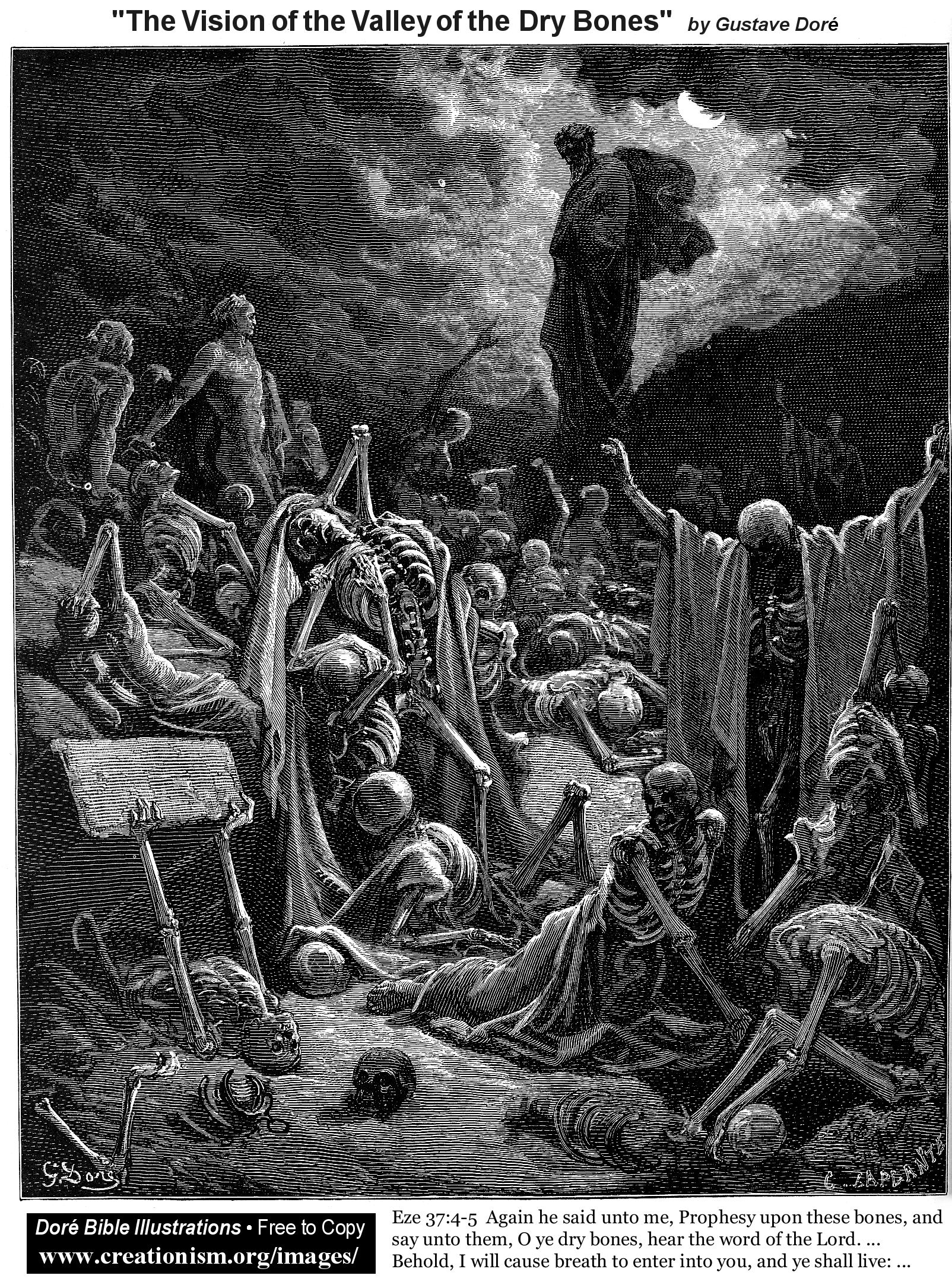
(Painting is of the "Valley of the Dry Bones" - same message!)

Tuesday, July 31, 2007

One Must Destroy in Order to Build- Part II


This post is a continuation of a similar theme in this post.
In the the 15th perek of Bilvavi Mishkan Evneh Vol 2, the author writes about the concept in Mishlei 24:16, "כִּי שֶׁבַע, יִפּוֹל צַדִּיק וָקָם," that the Tzadik must fall seven times and then get up. He brings down the concept that those failures (whether in thought, wanting, speech, or action) are not an obstacle to growth, but an integral part of the process.

He illustrates this with a startling ma'aseh about the GR"A and his Talmid, Rav Chaim Volozhiner. He says that the GR"A put himself through a self-imposed exile for a period of time. When he returned, his talmid Rav Chaim asked him whether or not he should also engage in that same avodah of self-imposed exile. The GR"A responded that, "I did it, but now I regret it." (Ostensibly the trials of exile disturbed his Torah learning, but the author doesn't go into the reasons he regreted it.) Rav Chaim, his student, responded, "Then I will do as you did. I will go into exile and then I will regret it."

The ma'aseh seems almost incomprehensible at first glance. Shouldn't Rav Chaim have learned from his rebbe's mistakes and not repeated them? However, the purpose of the ma'aseh is to teach this counter-intuitive yesod: We grow into the bigger Jews not by continuous successes in avodas Hashem, but specifically because of the failures.

I saw this illustrated in another way through a Tosafos in Avoda Zara 34a. The Gemara is discussing how clay vessels that are lined with not-fully-"cooked" glass (according to Tosafos) can never be kashered (if they were used for hot non-kosher food). Tosafos ask on this that we see from another gemara that a clay vessel can be kashered by re-firing it in the kiln! He answers that though it is true that the vessel would become usable that way, it is not because the vessel is called "kashered." It is because when it emerges from the kiln, it is considered a totally new vessel, not a kashered old vessel. "Kashering" a non-kosher clay vessel is impossible.

I see this as an expression/mashal of this same yesod on a physical level, when it comes to absorbtion of traif food in clay vessels. "For [we are like] clay in the hands of the Potter." We are also compaired to clay vessels. We also cannot fully give up what is not-kosher about ourselves without going into the fire and nullifying the "self" so that when we come out, we will be new Jews, able to ascend to the next level, unencumbered by past failures. But it is only through destruction/failure, that we can be a new vessel again to receive the Divine light.

-Dixie Yid

(Picture is courtesy of YellowLeaf.org)

Monday, July 23, 2007

One Must Destroy in Order to Build


I was reading a recent post at Beyond BT that's worth seeing. In it, Katrin told the story of the great tragedies in the life of a Rabbi Shaul Rosenblatt. The tragedies he endured in his life and story of the death of his wife at the age of about 30, reminded me that sometimes Hashem knows that the only way to allow people to grow to a greater level is by first destroying them.

This is a great truth that we must accept if we want to grow into bigger Jews. One must destroy who he is now (including the good parts) if he wants to attain a new, higher and more exalted level than before. A greater self cannot be built on a lesser self. The lesser self must first be obliterated. There are many places where one sees this universal truth.

In hilchos Shabbos, destroying is not forbidden unless it is done in order to build. Tearing is only proscribed when it is along a seam in order to re-sew another garment. This indicates that the true purpose of "destroying" is as a "constructive" force, when it is used in the purpose of building something greater in its place. Therefore, when one is mevatel and he obliterates his current self, it cannot be done in a destructive way, but rather it must be a destruction similar to the dismantling and tearing in hilchos Shabbos, which is done in a constructive way, to build something greater in its place.

Even the neshoma after Geheinom, which is delighting in a sublimity of Divine revelation that we, who are still confined to human form, cannot fathom, must go through a type of destruction in order to ascend to higher levels of Gan Eden. When a neshoma is enjoying pleasures of the Divine Presence that we cannot contemplate in Gan Eden Tachton (lower Gan Eden), it cannot fathom the even greater Divine light of Gan Eden Elyon (upper Gan Eden). In order for that neshoma to ascend to the higher level of Gan Eden, it must first immerse in the Nahar Dinur, the "River of Fire." This Geheinom-like process of suffering and destruction is necessary in order to attain the higher level of Gan Eden Elyon.

Why is the necessary to destroy one's lower level in order to attain a higher level? To not do so would be comparable to pouring fine wine into a vessel with the remnants of cheap wine still in it. The greater level of the finer wine will be nullified by the presence of the cheap wine. To reach a qualitatively different level, the old level must be destroyed so it does not ruin and nullify the effect of the higher level.

A friend of mine offered another moshel. We know that everything in the world is moshol for the true spiritual reality so this concept is found in the physical world in innumerable ways. My friend pointed out that when one want to build his muscles, it is not enough to build them by working them out through exercise and lifing weights. The muscles must be worked so hard to the point of becoming ripped in many places. It is only through the rebuilding of the muscles after ripping that they can achieve the bulk the bodybuilder desires.

This is why Hashem decreed that we go through hundreds of years of slavery and exile in Egypt. He intended to make us feel so broken and cut-off from Him, that our entire relationship with Hashem that had been built up by the Avos was destroyed. It was only after this cutting-off and destroying in the Kur Habarzel (Nesira) that we could re-create our relationship with Hashem as one of Panim b'Panim and not Achor b'Achor (intimate love similar to that of husband and wife and not cool love similar to that of parent and child) through the miracles and the Sinai experience.

This is also why every single peshat that you will hear or read from a rabbi or friend is preceded by a Kasha, a question on your existing understanding of some pasuk/gemara/mishna/halacha. Even if the kasha is weak, people always start off by asking one. This is because of this unconsciously known general truth. Only when there's something you don't understand and your previously conceived understanding of some text is nullified by a kasha can you then be opened up to hear the new pshat. People never just start a speech by saying a new peshat on a text without first asking a kasha on some other understanding of that text.

There are countless other examples of this. I am actually somewhat uncomfortable writing this post without citing any sources. I don't like to do that at all because no one knows whether I am saying things that come from my own imagination or are based on some true source (except those that already know what I'm saying). However, I really don't remember which seforim or shiurim I've learned many of these examples and ideas from specifically. It's more of just a compilation of some of the ideas I know in this topic so I apologize for readers who have nothing to look to that I can cite to double-check the accuracy of what I've written.

May Hashem give us the bravery and strength not to be afraid to be mevatel our current selves in order to build greater selves.

-Dixie Yid

P.S. Passionate Life quoted this piece in his blog, Passionate Life, in a very interesting post of his own on why Emunah in Hashem's Torah is vital to the marital relationship.

Monday, June 18, 2007

Baki B'ratzo Baki B'Shov - R' Itchie Mayer Morgenstern


My friend Rabbi Reuven Boshnack, of כדאי To See Inside and Izbitza, introduced me to a piece in Yam Hachochma from 5767 (2007) on Rebbe Nachman's teaching that one must be Baki B'ratzo Baki B'Shov (Likutei Moharan 6), in order to walk in the path of Teshuva. In it, Rav Itchie Mayer Morgenstern says that the way you must be Baki B'shov is that you must cling to the aspect of the lower Yud of the letter Alef.

What does this mean? The letter alef is made up of three letters. There's a right-side-up Yud at the top of the letter. At the bottom is an upside-down and backwards Yud. And connecting the two is the letter Vav. What does it mean to connect one's self to the lower Yud? This means feeling the bizyonos and the humiliation of having failed a test and done an aveira. One is in his "Shov," retreating period at that time. When you feel humiliated at having failed and you realize that you're totally incapable of returning to Hashem and being the right kind of Jew without Hashem's help, then you're clingining to the lower Yud. The lower Yud is upside-down and backwards. It's messed up, just as one feels messed up when he's failed. (The idea of the liberatingly honest feeling of shame after failure is also hinted at in Oros Hateshuva by Rav Kook 14:24.)

When one feels this way, he can be connected and drawn up through the middle Vav, back up to Hashem to be a Tazdik the way he's supposed to be. This is also referenced in the letter Alef because the Vav is the letter of connection. In grammer, the Vav means "and." It's called the "Vav Hachibur," the Vav which connects one idea to the next, because it means "and." It's also called the "Vav Hahifuch," "Vav which transforms" because gramatically it transforms past tense to future tense and future tense to past tense, in the Chumash. In this context, the Vav within the letter Alef connects the person to the upper Point of existance, Hashem, and transforms him back to a place of Ratzo, running towards Hashem.

-Dixie Yid